English
 Español
 tiếng việt
 русский
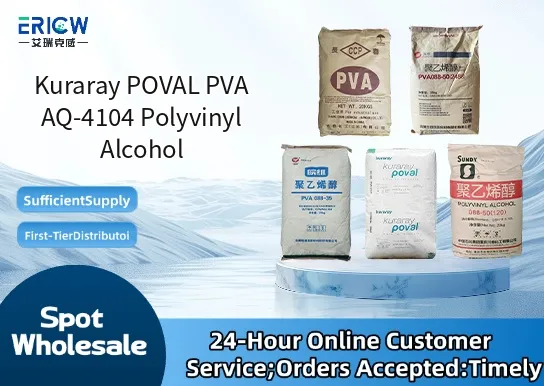
High water solubility with rapid dissolution in cold to warm water.
Excellent film-forming capability and strong adhesion to polar substrates.
Good compatibility with starch, cellulose derivatives, and various water-soluble polymers.
Low residual acetyl content ensures enhanced hydrophilicity and biodegradability.
Consistent batch-to-batch quality supported by Kuraray’s stringent GMP-aligned manufacturing control.
Water-soluble packaging films for agrochemicals and detergent pods.
Binder in ceramic green bodies and refractory shaping processes.
Thickener and stabilizer in aqueous pigment dispersions for inkjet inks.
Temporary protective coating for metal surface passivation during machining.
Matrix component in pharmaceutical fast-dissolving films (FDFs) and oral thin films.
| Chemical Type | Polyvinyl alcohol (partially hydrolyzed) |
| Product Form | White to off-white free-flowing powder |
| Appearance | Free-flowing granular or powdered solid |
| Saponification Degree (mol %) | 87–89 |
| Viscosity (4% aqueous solution at 20°C) | 3.8–4.5 mPa·s |
| Residual Acetate Content (wt %) | ≤12.0 |
| pH (1% aqueous solution) | 5.5–7.5 |
| Moisture Content (wt %) | ≤5.0 |
Q1: What is the primary functional role of POVAL PVA AQ-4104 in water-based formulations?
A: POVAL PVA AQ-4104 functions primarily as a film-forming binder and rheology modifier in aqueous systems. Its partial hydrolysis profile provides balanced water solubility and cohesive strength, making it especially suitable for applications requiring rapid dissolution and robust dry-film integrity.
Q2: How does AQ-4104 compare to fully hydrolyzed PVAs in terms of moisture resistance and processing behavior?
A: Compared to fully hydrolyzed grades, AQ-4104 offers improved cold-water solubility and faster dissolution kinetics due to its lower degree of hydrolysis. While it forms films with moderate moisture sensitivity, this characteristic supports easier rewettability and compatibility with water-soluble packaging or temporary barrier layers.
Q3: Is POVAL PVA AQ-4104 compatible with common crosslinkers used in coating or adhesive formulations?
A: Yes — AQ-4104 is compatible with aldehyde-based crosslinkers (e.g., glyoxal, formaldehyde derivatives) and certain multifunctional aziridines under controlled pH and temperature conditions. Compatibility should be verified empirically, as reactivity depends on formulation pH, solids content, and thermal history.
Q4: What are typical handling and storage recommendations to maintain product stability?
A: Store in original unopened packaging at temperatures between 5–30 °C, away from direct sunlight and sources of humidity. Once dissolved, aqueous solutions should be used within a few days and protected from microbial growth using appropriate preservatives if extended storage is required.
Contact With Us:
E-mail: wangxingqiang@ericwchem.com
Have a Questions? Call Us:
Add:
Building A1, Jiete Industrial Park, Huangpu District, Guangzhou City, Guangdong Province, China