English
 Español
 tiếng việt
 русский
Exceptional adhesion to glass and various substrates, ensuring reliable interlayer bonding in laminated safety glass.
High optical clarity and low haze, meeting stringent requirements for automotive and architectural glazing.
Outstanding UV resistance and long-term weatherability, minimizing yellowing and maintaining performance under prolonged sunlight exposure.
Optimized rheology for efficient casting and lamination processes, enabling consistent film formation and minimal defects.
Consistent batch-to-batch quality with tight molecular weight distribution, supporting reproducible manufacturing outcomes.
Automotive laminated windshields and side windows.
Architectural safety glass for facades, skylights, and overhead glazing.
Security glazing systems requiring bullet-resistant or blast-mitigating performance.
Solar photovoltaic module encapsulation (frontsheet interlayer).
Acoustic laminated glass for noise reduction in transportation and building envelopes.
| Chemical Type | Polyvinyl butyral (PVB) resin |
| Product Form | Free-flowing white granules |
| Appearance | Off-white to light yellow granular solid |
| Primary Applications | Laminated safety glass interlayer |
| Key Features | High adhesion, UV stability, optical clarity, processability |
| Benefits | Enhanced safety, durability, acoustic insulation, and design flexibility |
| Storage Conditions | Store in cool, dry place; protect from moisture and direct sunlight |
| Compliance | Meets ISO 12543 and EN 14449 standards for PVB interlayers |
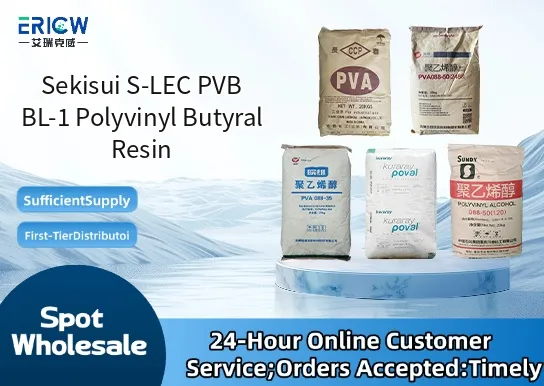
Q1: What is the primary function of S-LEC PVB BL-1 in adhesive and coating formulations?
A: S-LEC PVB BL-1 serves as a high-performance film-forming binder and adhesion promoter, particularly valued for its excellent substrate wetting, flexibility, and compatibility with polar solvents and other resin systems such as acrylics and epoxies.
Q2: Is S-LEC PVB BL-1 suitable for use in safety glass interlayers?
A: No — S-LEC PVB BL-1 is specifically formulated for industrial coatings, inks, and adhesive applications, not for laminated safety glass interlayers. Sekisui offers distinct PVB grades optimized for architectural and automotive laminated glass, which differ significantly in molecular weight, plasticizer content, and processing requirements.
Q3: How does S-LEC PVB BL-1 contribute to moisture resistance in protective coatings?
A: Due to its inherently low water absorption and strong hydrogen-bonding capability, S-LEC PVB BL-1 enhances cohesive strength and barrier properties in solvent-based coatings, helping to reduce blistering and delamination under humid conditions — especially when used in combination with hydrophobic resins.
Q4: What solvents are recommended for dissolving S-LEC PVB BL-1?
A: It exhibits good solubility in common oxygenated solvents such as ethanol, isopropanol, n-butanol, ethyl acetate, and ketones like MEK and acetone — either individually or in carefully balanced blends — enabling formulation flexibility across various coating viscosity and drying rate requirements.
Contact With Us:
E-mail: wangxingqiang@ericwchem.com
Have a Questions? Call Us:
Add:
Building A1, Jiete Industrial Park, Huangpu District, Guangzhou City, Guangdong Province, China