English
 Español
 tiếng việt
 русский
High adhesion strength to glass and various substrates, ensuring reliable interlayer bonding in laminated safety glass.
Excellent optical clarity and low haze, meeting stringent requirements for automotive and architectural glazing.
Superior impact resistance and tear propagation resistance under dynamic loading conditions.
Good thermal stability and consistent melt flow behavior during industrial calendering and extrusion processes.
Low residual acetyl content, contributing to enhanced long-term yellowing resistance and UV stability.
Laminated automotive windshields and side windows.
Architectural safety glass for facades, skylights, and overhead glazing.
Security glazing systems including blast-resistant and bullet-resistant laminates.
Photovoltaic module encapsulation layers for enhanced moisture barrier performance.
Acoustic interlayers in noise-reducing laminated glass solutions.
| Chemical Type | Polyvinyl butyral (PVB) resin |
| Product Form | Free-flowing granular powder |
| Appearance | Off-white to light yellow granules |
| Primary Applications | Safety glass interlayer, photovoltaic encapsulation, acoustic laminates |
| Key Features | High adhesion, optical clarity, impact resistance, thermal processability |
| Benefits | Improved laminate durability, reduced delamination risk, compatibility with standard PVB processing lines |
| Storage Conditions | Store in cool, dry, well-ventilated area; protect from moisture and direct sunlight |
| Shelf Life | 24 months from date of manufacture under recommended storage conditions |
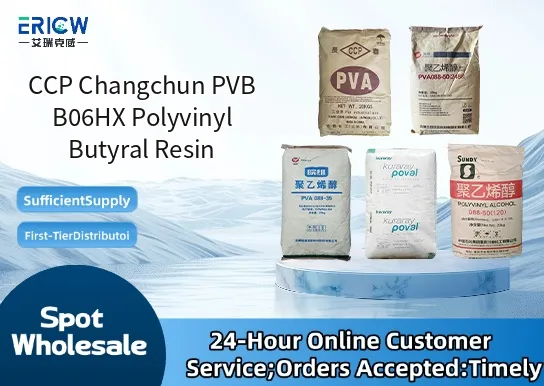
Q1: What are the key performance advantages of CCP Changchun PVB B06HX compared to standard PVB resins?
A: CCP Changchun PVB B06HX offers enhanced film-forming capability, improved compatibility with polar polymers and plasticizers, and superior adhesion to glass and metal substrates—making it especially suitable for high-performance interlayer and coating applications where clarity, toughness, and environmental stability are critical.
Q2: Is PVB B06HX compatible with common plasticizers used in safety glazing interlayers?
A: Yes, PVB B06HX demonstrates excellent compatibility with conventional plasticizers such as triethylene glycol di-2-ethylhexanoate (3GO) and dipropylene glycol dibenzoate (DPGDB), supporting uniform dispersion and long-term stability in interlayer formulations.
Q3: How should PVB B06HX be handled and stored to maintain optimal performance?
A: Store in original sealed packaging under cool, dry conditions away from direct sunlight and sources of heat or moisture. Avoid prolonged exposure to ambient humidity prior to processing, as PVB resins are hygroscopic and may require pre-drying depending on processing conditions and equipment.
Q4: Can PVB B06HX be used in solvent-based versus aqueous coating systems?
A: PVB B06HX is primarily designed for use in solvent-based systems—including alcohols, ketones, and ester blends—and delivers consistent solubility and solution viscosity. While not typically formulated for water-based systems, modified dispersions may be achievable with appropriate surfactants and stabilization techniques, subject to application-specific validation.
Contact With Us:
E-mail: wangxingqiang@ericwchem.com
Have a Questions? Call Us:
Add:
Building A1, Jiete Industrial Park, Huangpu District, Guangzhou City, Guangdong Province, China