English
 Español
 tiếng việt
 русский
Excellent adhesion to glass and various substrates, ensuring robust interlayer bonding in laminated safety glass.
High optical clarity and low haze, meeting stringent requirements for automotive and architectural glazing applications.
Superior impact resistance and tear propagation control under dynamic loading conditions.
Consistent thermal stability during lamination processing (130–150 °C), minimizing bubble formation and delamination risk.
Low moisture absorption rate, enhancing long-term dimensional stability and interfacial durability.
Automotive laminated windshields and side windows.
Architectural safety glazing for commercial buildings and facades.
Security glazing systems including bullet-resistant and blast-resistant laminates.
Solar photovoltaic module encapsulation layers.
Acoustic laminated glass for noise reduction in transportation and urban infrastructure.
| Chemical Type | Polyvinyl butyral (PVB) resin |
| Product Form | Free-flowing white granules |
| Appearance | Off-white to light yellow, uniform granular solid |
| Primary Applications | Laminated safety glass interlayer |
| Key Features | High tensile strength, excellent melt flow, UV stability |
| Benefits | Enhanced optical performance, reliable lamination yield, consistent batch-to-batch quality |
| Storage Conditions | Store in dry, cool, well-ventilated area; protect from moisture and direct sunlight |
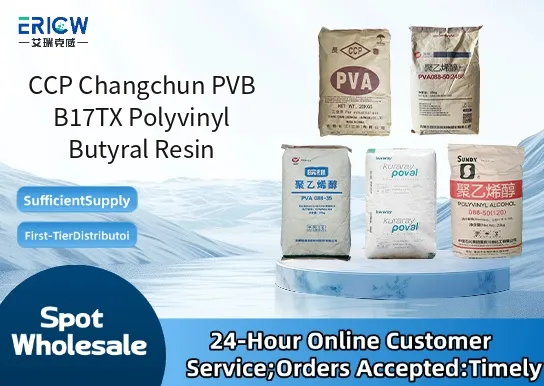
| Standard Packaging | 25 kg multi-layer kraft paper bag with inner polyethylene liner |
Q1: What are the key performance advantages of CCP Changchun PVB B17TX compared to standard PVB resins?
A: CCP Changchun PVB B17TX offers enhanced compatibility with polar polymers and improved film-forming characteristics, resulting in superior adhesion, flexibility, and clarity in final formulations—particularly beneficial for high-performance interlayer and coating applications.
Q2: Is PVB B17TX suitable for use in safety glass interlayers?
A: Yes—B17TX is specifically engineered for laminated safety glass applications, delivering excellent optical transparency, impact resistance, and long-term durability under varying environmental conditions. Its molecular structure supports strong bonding between glass plies and consistent processing behavior during autoclaving.
Q3: How should PVB B17TX be dried and handled prior to processing?
A: Prior to melt processing or solution preparation, PVB B17TX should be dried at moderate temperatures (e.g., 50–60 °C) under vacuum or low-humidity air flow to minimize moisture content—excess moisture can lead to bubble formation or reduced melt stability during extrusion or casting.
Q4: Can PVB B17TX be blended with other thermoplastic resins?
A: Yes—B17TX demonstrates good miscibility with several common thermoplastics including acrylics, certain polyesters, and cellulose derivatives. Compatibility testing is recommended for each specific blend system to ensure phase stability, thermal behavior, and end-use performance meet application requirements.
Q5: What solvent systems are commonly used to dissolve PVB B17TX for coating or adhesive applications?
A: B17TX dissolves readily in mixtures containing alcohols (e.g., ethanol, isopropanol), ketones (e.g., methyl ethyl ketone), and esters (e.g., ethyl acetate). Optimal solvent selection depends on desired viscosity, drying rate, and substrate compatibility—formulators often use balanced blends to achieve target solution properties.
Contact With Us:
E-mail: wangxingqiang@ericwchem.com
Have a Questions? Call Us:
Add:
Building A1, Jiete Industrial Park, Huangpu District, Guangzhou City, Guangdong Province, China