English
 Español
 tiếng việt
 русский
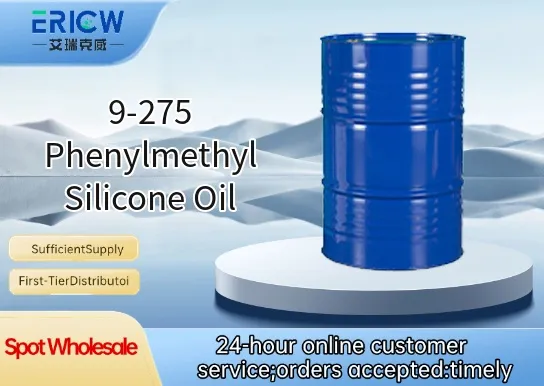
Excellent thermal stability up to 250 °C, maintaining viscosity integrity under prolonged high-temperature exposure.
Superior oxidative resistance due to phenyl group incorporation, minimizing degradation in air-rich environments.
Low volatility and high flash point, enhancing safety during high-temperature processing and storage.
Broad compatibility with organic resins, elastomers, and coating systems without phase separation.
Outstanding electrical insulation properties with low dielectric loss across wide temperature and frequency ranges.
High-temperature heat transfer fluids in industrial ovens and curing systems.
Dielectric coolant and impregnation medium for high-voltage transformers and electronic encapsulants.
Release agent for silicone rubber and polyimide film molding at elevated temperatures.
Base fluid in specialty lubricating greases for aerospace and automotive precision bearings.
Viscosity modifier and surface conditioner in high-performance protective coatings and anti-stick formulations.
| Chemical Type | Phenylmethyl polysiloxane |
| Product Form | Clear, colorless to pale yellow liquid |
| Appearance | Homogeneous, transparent, odorless |
| Viscosity (25 °C, cSt) | 275 ± 15 |
| Density (25 °C, g/cm³) | 1.03–1.06 |
| Flash Point (COC, °C) | ≥ 310 |
| Refractive Index (25 °C) | 1.520–1.535 |
| Key Features | Thermally stable, oxidation resistant, low volatility, electrically insulating |
Q1: What distinguishes 9-275 Phenylmethyl Silicone Oil from standard dimethyl silicone oils?
A: The phenyl groups in its molecular structure significantly enhance thermal stability, UV resistance, and compatibility with aromatic solvents and resins—making it especially suitable for high-performance coatings, specialty adhesives, and optical applications where conventional dimethyl silicones may degrade or phase-separate.
Q2: Is 9-275 compatible with common industrial polymers and resins?
A: Yes—it demonstrates good miscibility with epoxy, polyurethane, acrylic, and polyester systems, particularly in formulations requiring improved substrate wetting, reduced surface tension, or enhanced release characteristics. Compatibility should be verified under actual processing conditions due to formulation-specific variables.
Q3: How is 9-275 typically incorporated into formulations?
A: It is generally added during the late-stage mixing phase to minimize shear-induced degradation and ensure uniform dispersion. Dosage depends on formulation requirements but is typically used at low concentrations—often ranging from 0.1% to 2% by weight—to achieve desired surface effects without compromising bulk properties.
Q4: Does 9-275 exhibit volatility concerns during high-temperature processing?
A: Due to its phenyl substitution and higher molecular weight distribution, 9-275 shows markedly lower volatility compared to low-viscosity dimethyl silicone oils—making it well-suited for applications involving extended baking, curing, or extrusion at elevated temperatures.
Contact With Us:
E-mail: wangxingqiang@ericwchem.com
Have a Questions? Call Us:
Add:
Building A1, Jiete Industrial Park, Huangpu District, Guangzhou City, Guangdong Province, China