English
 Español
 tiếng việt
 русский
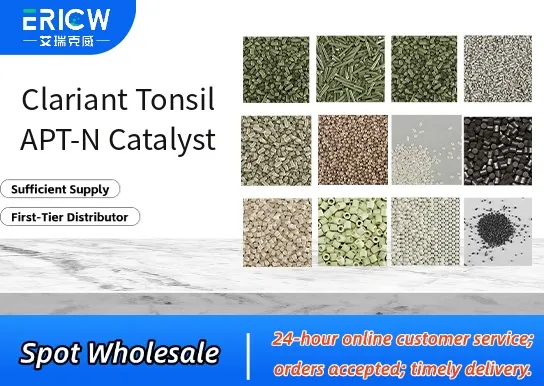
Highly selective acid catalyst for esterification and transesterification reactions.
Thermally stable solid acid with low leaching risk under process conditions.
Non-corrosive alternative to liquid mineral acids, enhancing operational safety.
Easy to separate and regenerate, supporting sustainable and cost-efficient processes.
Consistent performance across batch and continuous reactor systems.
Biodiesel production via transesterification of vegetable oils and animal fats.
Synthesis of biodegradable plasticizers such as citrate and adipate esters.
Ester-based lubricant additives manufacturing.
Flavor and fragrance ester synthesis requiring high-purity output.
Pharmaceutical intermediate preparation involving mild acidic catalysis.
| Chemical Type | Activated clay-based solid acid catalyst |
| Product Form | Free-flowing granular solid |
| Appearance | Light grey to beige granules |
| Primary Applications | Esterification, transesterification, acylation |
| Key Features | Non-toxic, non-volatile, heterogeneous |
| Benefits | Reduced waste, simplified downstream separation, corrosion-free handling |
| Storage Conditions | Store in dry, well-ventilated area; protect from moisture |
| Regeneration Capability | Yes — thermal regeneration possible after deactivation |
Q1: What is the primary function of Tonsil APT-N in polymer processing?
A: Tonsil APT-N is a high-performance acid-activated bentonite clay catalyst designed to promote condensation reactions—particularly in silicone and polyurethane systems—by enhancing crosslinking efficiency and improving thermal stability of the final cured material.
Q2: Is Tonsil APT-N compatible with food-contact or pharmaceutical-grade formulations?
A: Tonsil APT-N is not pre-qualified for direct food-contact or pharmaceutical applications. Its suitability for such uses depends on full regulatory assessment by the end-formulator, including compatibility testing and compliance verification with applicable regional requirements.
Q3: How should Tonsil APT-N be incorporated into a formulation?
A: It is typically added during the mixing stage under controlled shear and temperature conditions. Pre-dispersion in a compatible carrier liquid or resin phase is recommended to ensure uniform distribution and avoid agglomeration.
Q4: Does Tonsil APT-N require activation or pre-treatment before use?
A: No—Tonsil APT-N is supplied in its fully activated form and does not require calcination, drying, or other pre-treatment steps prior to incorporation into standard industrial processes.
Contact With Us:
E-mail: wangxingqiang@ericwchem.com
Have a Questions? Call Us:
Add:
Building A1, Jiete Industrial Park, Huangpu District, Guangzhou City, Guangdong Province, China