English
 Español
 tiếng việt
 русский
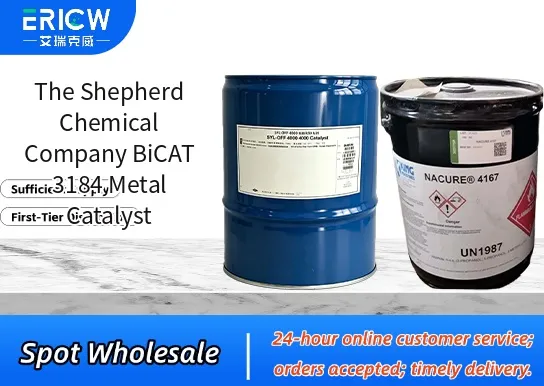
Highly active bismuth-based catalyst offering superior selectivity in polyurethane foam formation.
Non-toxic, heavy-metal-free alternative to traditional tin and amine catalysts.
Excellent hydrolytic stability ensuring consistent performance across varying humidity conditions.
Compatible with both flexible and rigid polyurethane formulations without compromising pot life.
Low volatility formulation minimizes emissions during processing and improves workplace safety.
Flexible slabstock polyurethane foam for bedding and furniture manufacturing.
Rigid polyurethane and polyisocyanurate (PIR) foams used in building insulation.
Integral skin and microcellular elastomer systems for automotive seating and trim.
Coating and adhesive systems requiring low-odor, low-VOC catalysis.
Water-blown foam formulations where amine catalysts cause undesirable odor or discoloration.
| Chemical Type | Bismuth carboxylate complex |
| Product Form | Clear, amber liquid |
| Appearance | Homogeneous free-flowing liquid |
| Primary Applications | Polyurethane foam catalysis (flexible & rigid) |
| Key Features | Heavy-metal-free, low-VOC, hydrolytically stable |
| Benefits | Reduced emissions, improved worker safety, enhanced foam cell structure |
| Storage Conditions | Store in original sealed container at 15–25°C; protect from moisture |
| Shelf Life | 24 months from date of manufacture when stored properly |
Q1: What is the primary chemical nature and intended function of BiCAT 3184?
A: BiCAT 3184 is a proprietary bismuth-based metal catalyst formulated to promote urethane and polyurea reactions—particularly in moisture-cured and ambient-cure systems—without the toxicity or regulatory restrictions associated with traditional heavy-metal catalysts like lead or mercury compounds.
Q2: Is BiCAT 3184 compatible with common polyol and isocyanate chemistries used in coatings and sealants?
A: Yes, BiCAT 3184 demonstrates broad compatibility with aromatic and aliphatic isocyanates (e.g., MDI, HDI, IPDI) and a wide range of polyols—including polyester, polyether, and polycarbonate types—making it suitable for high-performance industrial coatings, adhesives, and elastomeric sealants.
Q3: How does BiCAT 3184 compare to traditional tin-based catalysts such as DBTDL in terms of pot life and cure profile?
A: BiCAT 3184 typically offers longer working time (pot life) than highly reactive tin catalysts while still delivering robust through-cure at ambient conditions. Its reactivity is more balanced and less sensitive to trace moisture or acidic components, supporting improved formulation stability and reproducibility.
Q4: What is the recommended handling and storage guidance for BiCAT 3184?
A: Store in tightly sealed original containers at temperatures between 10°C and 30°C, away from direct sunlight and strong oxidizing agents. Avoid prolonged exposure to ambient humidity during handling, and use appropriate personal protective equipment (PPE) including gloves and eye protection consistent with standard industrial chemical hygiene practices.
Q5: Can BiCAT 3184 be used in formulations targeting low-VOC or non-isocyanate polyurethane alternatives?
A: While BiCAT 3184 is optimized for conventional isocyanate–hydroxyl chemistry, it has demonstrated utility in select hybrid systems incorporating latent isocyanates or moisture-scavenging co-catalysts. It is not designed for true non-isocyanate polyurethane (NIPU) chemistries based on cyclic carbonates or amines.
Contact With Us:
E-mail: wangxingqiang@ericwchem.com
Have a Questions? Call Us:
Add:
Building A1, Jiete Industrial Park, Huangpu District, Guangzhou City, Guangdong Province, China