English
 Español
 tiếng việt
 русский
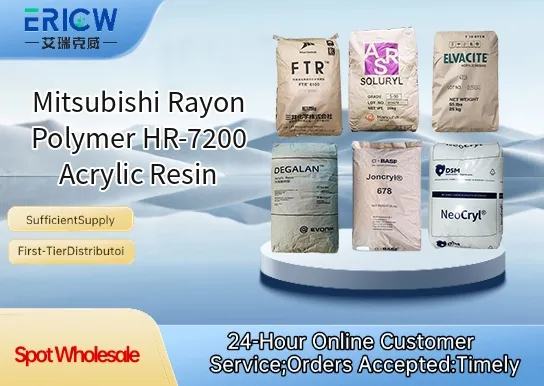
High molecular weight acrylic polymer delivering exceptional film strength and mechanical durability.
Excellent UV resistance and long-term color stability for outdoor exposure applications.
Good compatibility with common solvent-based coating systems and crosslinkers (e.g., melamine formaldehyde).
Low viscosity in aromatic and ketonic solvents, enabling high-solids formulation without sacrificing flow or leveling.
Consistent batch-to-batch reproducibility meeting stringent quality control standards for industrial coatings.
Automotive OEM clearcoats and topcoats requiring high gloss and mar resistance.
Industrial maintenance coatings for metal substrates exposed to harsh environments.
Architectural high-performance façade coatings and metallic-effect finishes.
Plastic coatings for automotive interior and exterior trim components.
Can coatings for beverage and food containers demanding FDA-compliant formulations.
| Chemical Type | Thermosetting acrylic copolymer |
| Product Form | Liquid resin solution |
| Appearance | Clear, pale yellow to colorless viscous liquid |
| Solvent System | Xylene / butyl acetate blend |
| Non-Volatile Content (NV) | 50 ± 2 wt% |
| Acid Value | 8–12 mg KOH/g |
| Hydroxyl Value | 65–75 mg KOH/g |
| Gardner Color | ≤3 |
Q1: What is the primary function of HR-7200 in coating formulations?
A: HR-7200 is a high-molecular-weight acrylic resin designed primarily as a rheology modifier and film-forming aid in solvent-based and high-solids industrial coatings. It enhances sag resistance, improves leveling, and contributes to durable, glossy finishes without compromising flow characteristics.
Q2: Is HR-7200 compatible with common crosslinkers used in thermosetting acrylic systems?
A: Yes, HR-7200 exhibits good compatibility with standard amino resins (e.g., melamine-formaldehyde) and polyisocyanate crosslinkers typically employed in baked or ambient-cure acrylic enamel systems. Compatibility should be verified in the final formulation due to sensitivity to solvent balance and acid value.
Q3: How does HR-7200 differ from conventional acrylic solution resins in terms of molecular architecture?
A: HR-7200 features a carefully controlled branched molecular structure and narrow molecular weight distribution, which provides superior solution viscosity stability and reduced shear-thinning behavior compared to linear acrylic resins—making it especially suitable for high-solids applications requiring consistent spray performance.
Q4: Can HR-7200 be used in UV-curable hybrid systems?
A: While HR-7200 itself is not photoreactive, it can be incorporated into UV-curable hybrid formulations (e.g., UV/moisture dual-cure or UV/thermal hybrids) as a non-volatile binder to improve film integrity and reduce shrinkage—provided that its solubility in reactive diluents and compatibility with photoinitiators are confirmed during pilot-scale testing.
Contact With Us:
E-mail: wangxingqiang@ericwchem.com
Have a Questions? Call Us:
Add:
Building A1, Jiete Industrial Park, Huangpu District, Guangzhou City, Guangdong Province, China