English
 Español
 tiếng việt
 русский
High-gloss, excellent flow and leveling for premium surface appearance.
Outstanding weather resistance and UV stability for long-term outdoor performance.
Good chemical resistance to solvents, acids, and alkalis in cured powder coatings.
Optimized reactivity for efficient curing at standard industrial bake schedules (180–200 °C).
Low melt viscosity enabling smooth film formation and reduced orange peel effect.
Architectural aluminum extrusions and curtain wall systems.
Automotive exterior trim and non-under-hood components.
Outdoor furniture and garden equipment coatings.
Industrial metal enclosures and signage requiring durable gloss retention.
Appliance front panels and decorative housings exposed to ambient conditions.
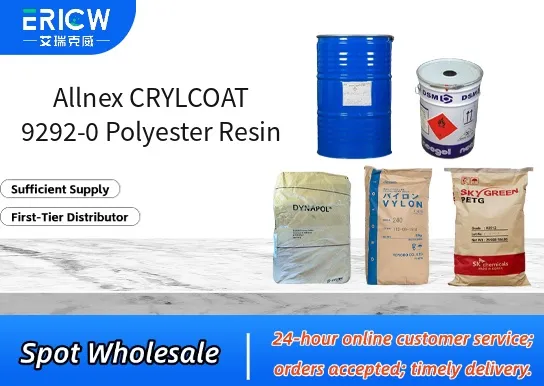
| Chemical Type | Carboxyl-functional saturated polyester |
| Product Form | Pellets |
| Appearance | Off-white to light beige, free-flowing pellets |
| Acid Value (mg KOH/g) | 27–31 |
| Gardner Color | ≤ 3 |
| Melt Viscosity (200 °C, Pa·s) | 2,500–4,000 |
| Softening Point (°C, Ring & Ball) | 78–84 |
| Key Features | Weather-resistant, high-gloss, low-melt-viscosity, UV-stable |
Q1: What is the primary application of CRYLCOAT 9292-0 in powder coatings?
A: CRYLCOAT 9292-0 is a carboxyl-functional polyester resin specifically designed as a binder for TGIC-free, high-gloss, decorative powder coatings—especially where excellent flow, leveling, and weather resistance are required.
Q2: Is CRYLCOAT 9292-0 compatible with common crosslinkers used in polyester-based powder systems?
A: Yes—it is formulated to react efficiently with standard epoxy-functional crosslinkers such as glycidyl ester (GMA) acrylics and triglycidyl isocyanurate (TGIC), enabling robust cure profiles across conventional and low-bake conditions.
Q3: How does CRYLCOAT 9292-0 perform under outdoor exposure conditions?
A: It delivers strong UV stability and long-term gloss retention due to its optimized aromatic/aliphatic backbone structure, making it suitable for exterior architectural and general industrial applications demanding proven weatherability.
Q4: What are typical processing considerations during extrusion and curing?
A: The resin exhibits good melt viscosity and dispersion behavior during extrusion. It cures effectively within standard powder coating temperature ranges (typically 180–200 °C for 10–20 minutes), supporting consistent film formation and mechanical properties without excessive yellowing.
Contact With Us:
E-mail: wangxingqiang@ericwchem.com
Have a Questions? Call Us:
Add:
Building A1, Jiete Industrial Park, Huangpu District, Guangzhou City, Guangdong Province, China