English
 Español
 tiếng việt
 русский
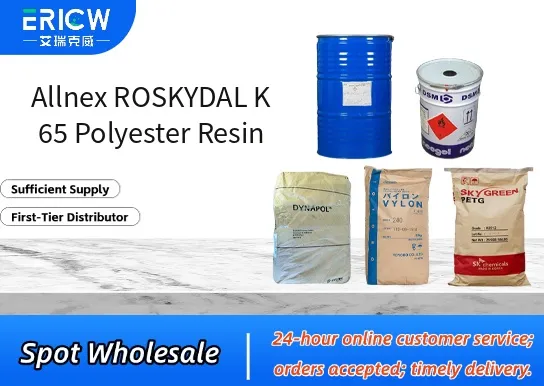
High-solids, low-VOC alkyd-modified polyester resin for sustainable coating formulations.
Excellent compatibility with amino resins and common crosslinkers for thermoset systems.
Good flow and leveling characteristics enabling smooth, high-gloss finishes.
Enhanced hardness development and early block resistance in baked coatings.
Consistent batch-to-batch performance supported by Allnex’s stringent quality control.
Automotive OEM and refinish topcoats requiring durability and gloss retention.
Industrial coil coatings for pre-painted metal substrates.
General-purpose appliance coatings (refrigerators, washing machines).
Architectural metal cladding and façade systems.
High-performance furniture and office equipment coatings.
| Chemical Type | Alkyd-modified saturated polyester resin |
| Product Form | Liquid |
| Appearance | Clear to pale yellow viscous liquid |
| Solvent System | Xylene/toluene-based (standard grade) |
| Solids Content (wt%) | 65 ± 1 % |
| Acid Value (mg KOH/g) | 8–12 |
| Hydroxyl Value (mg KOH/g) | 100–115 |
| Viscosity (25°C, mPa·s) | 4,000–6,000 |
Q1: What is the primary function of ROSKYDAL K 65 in coating formulations?
A: ROSKYDAL K 65 is a low-viscosity, high-solids unsaturated polyester resin designed primarily as a reactive diluent and film-forming binder in UV-curable and thermally cured coil, can, and general industrial coatings. It contributes to improved crosslink density, hardness development, and chemical resistance without requiring high levels of volatile organic compounds.
Q2: Is ROSKYDAL K 65 compatible with common photoinitiators used in UV-curable systems?
A: Yes, ROSKYDAL K 65 exhibits good compatibility with standard free-radical photoinitiators such as benzophenone derivatives and alpha-hydroxy ketones. Its unsaturation profile supports efficient radical polymerization under UV exposure, though optimal initiator selection and dosage should be confirmed through formulation-specific testing.
Q3: How does ROSKYDAL K 65 perform in terms of flexibility and adhesion on metal substrates?
A: ROSKYDAL K 65 delivers balanced flexibility and strong adhesion to pretreated steel and aluminum substrates—key requirements for coil and can coatings. Its molecular architecture supports good elongation without compromising hardness, helping maintain integrity during forming and impact processes.
Q4: Can ROSKYDAL K 65 be blended with other resins such as acrylics or epoxies?
A: Yes, ROSKYDAL K 65 is commonly blended with acrylic resins, epoxy esters, and other unsaturated polyesters to tailor cure speed, film properties, and substrate performance. Compatibility should be verified experimentally, particularly regarding storage stability and phase behavior in solvent- or water-based systems.
Contact With Us:
E-mail: wangxingqiang@ericwchem.com
Have a Questions? Call Us:
Add:
Building A1, Jiete Industrial Park, Huangpu District, Guangzhou City, Guangdong Province, China