English
 Español
 tiếng việt
 русский
Excellent abrasion resistance for extended service life in demanding mechanical environments.
Outstanding low-temperature flexibility down to –40 °C without brittle failure.
Good processability via injection molding, extrusion, and blow molding with minimal thermal degradation.
High transparency and gloss retention in thin-walled parts and optical-grade applications.
Hydrolysis-stabilized formulation suitable for humid or warm-condition processing and end-use.
Transparent protective films for electronics and automotive interior trim.
Soft-touch overmolded grips for power tools, medical devices, and consumer electronics.
Flexible tubing and bellows requiring clarity, kink resistance, and biocompatibility support.
High-gloss decorative trim components in automotive and appliance markets.
| Chemical Type | Aliphatic polyester-based thermoplastic polyurethane (TPU) |
| Product Form | Pellets (standard free-flowing, cylindrical) |
| Appearance | Translucent to clear, natural color (slight yellowish tint) |
| Primary Applications | Transparent soft-touch overmolding, protective films, flexible tubing |
| Key Features | Hydrolysis-stable, low-temperature flexible, high clarity, good melt stability |
| Processing Methods | Injection molding, extrusion, blow molding |
| Density (g/cm³) | 1.18–1.20 (ASTM D792) |
| Melt Flow Index (g/10 min) | 10–15 (at 210 °C / 5 kg, ASTM D1238) |
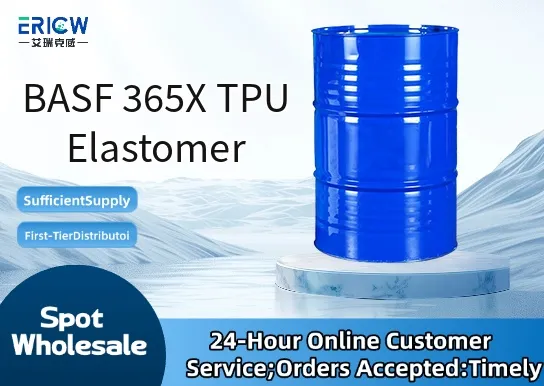
Q1: What is the primary function of BASF 365X in TPU formulations?
A: BASF 365X is a high-performance processing aid designed to improve melt flow, reduce extrusion torque, and enhance surface finish in thermoplastic polyurethane (TPU) compounds—particularly during extrusion and injection molding processes.
Q2: Is BASF 365X compatible with all major TPU chemistries (e.g., polyester-, polyether-, and polycaprolactone-based TPUs)?
A: Yes, BASF 365X demonstrates broad compatibility across common TPU base resins. It is especially effective in demanding applications involving high-molecular-weight or highly viscous grades where melt homogeneity and die swell control are critical.
Q3: How is BASF 365X typically incorporated into TPU production?
A: It is commonly added directly to the TPU resin via gravimetric or volumetric feeders prior to extrusion, or pre-blended as a masterbatch. Due to its low volatility and thermal stability, it remains effective under standard TPU processing temperatures without significant degradation or volatilization.
Q4: Does BASF 365X affect the mechanical properties or long-term performance of finished TPU parts?
A: When used within recommended dosage ranges, BASF 365X does not adversely impact tensile strength, elongation at break, or Shore hardness. It is formulated to remain molecularly dispersed and does not interfere with phase separation or physical crosslinking mechanisms inherent to TPU microstructure.
Contact With Us:
E-mail: wangxingqiang@ericwchem.com
Have a Questions? Call Us:
Add:
Building A1, Jiete Industrial Park, Huangpu District, Guangzhou City, Guangdong Province, China