English
 Español
 tiếng việt
 русский
Excellent balance of thermoplastic processability and elastomeric performance.
High tensile strength and outstanding resilience at elevated temperatures.
Good resistance to oils, greases, and common industrial chemicals.
Superior low-temperature flexibility down to –40 °C.
Easy to process via injection molding, extrusion, and blow molding without pre-drying.
Automotive under-hood components including air ducts and sensor housings.
Industrial hoses and fluid transfer tubing requiring dynamic flex life.
Consumer electronics casings and protective gaskets demanding impact absorption.
Medical device components requiring biocompatibility-supporting formulations (ISO 10993 compatible base polymer).
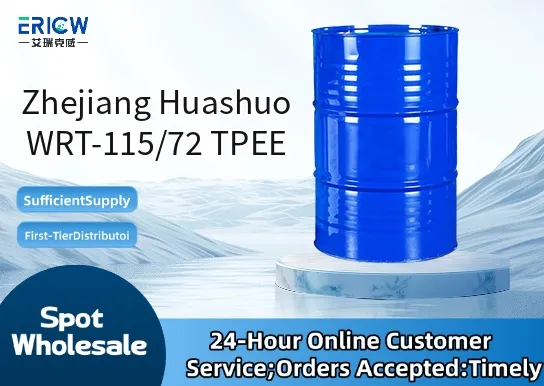
| Chemical Type | Thermoplastic Polyester Elastomer (TPEE) |
| Product Form | Pellets |
| Appearance | Off-white to light beige, free-flowing cylindrical pellets |
| Primary Applications | Dynamic mechanical parts, flexible structural components |
| Key Features | High hardness (Shore D 72), medium modulus, excellent fatigue resistance |
| Benefits | Reduced part weight vs. thermoset rubber; recyclable processing scrap |
| Processing Temperature Range | 220–260 °C (melt) |
Q1: What is the primary application domain for WRT-115/72 TPEE?
A: WRT-115/72 TPEE is primarily used in high-performance thermoplastic elastomer applications requiring excellent resilience, low-temperature flexibility, and good processability—such as automotive interior trim components, industrial hoses, and durable consumer goods requiring repeated flexing.
Q2: How does WRT-115/72 compare to standard polyester-based TPEEs in terms of melt processing?
A: WRT-115/72 offers improved melt flow characteristics compared to many conventional TPEEs, enabling smoother extrusion and injection molding at moderate temperatures. Its balanced hard-segment content supports stable processing without excessive thermal degradation during typical cycle times.
Q3: Is WRT-115/72 compatible with common engineering plastics for co-processing or alloying?
A: Yes—WRT-115/72 demonstrates good compatibility with polyesters (e.g., PET, PBT) and certain polyolefins when properly formulated. Compatibility with other polymers should be verified through small-scale blending trials and morphology evaluation.
Q4: What are the key storage and handling recommendations for this TPEE grade?
A: Store in original sealed packaging under cool, dry conditions away from direct sunlight and sources of moisture. Prior to processing, drying at 80–100 °C for 2–4 hours is recommended to maintain optimal mechanical performance and surface quality.
Contact With Us:
E-mail: wangxingqiang@ericwchem.com
Have a Questions? Call Us:
Add:
Building A1, Jiete Industrial Park, Huangpu District, Guangzhou City, Guangdong Province, China