English
 Español
 tiếng việt
 русский
High elasticity and excellent rebound resilience for dynamic sealing and cushioning applications.
Good processability via injection molding and extrusion, enabling efficient high-volume production.
Enhanced soft-touch feel with balanced hardness (Shore A 85) and low compression set.
Outstanding weather resistance and UV stability without additional stabilizer packages.
RoHS-compliant formulation with no halogens, phthalates, or heavy metals.
Automotive interior trim components including door panels, armrests, and center console overlays.
Consumer electronics housings and protective overmolded grips for power tools and appliances.
Medical device grips and non-critical wearable component housings requiring skin-safe contact.
Sealing profiles and gasketing solutions for outdoor enclosures and industrial equipment.
Soft-touch handles and ergonomic components in home and office furniture systems.
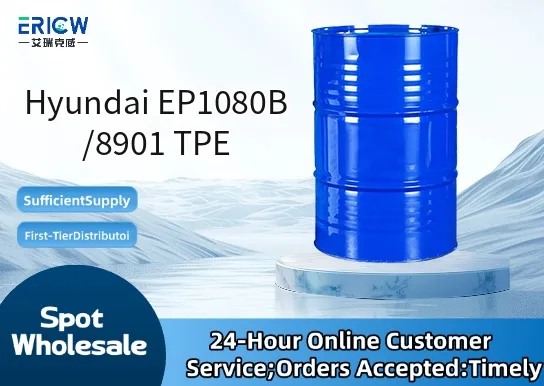
| Chemical Type | Thermoplastic Elastomer (TPE) – Styrenic Block Copolymer (SBC) based |
| Product Form | Pellets |
| Appearance | Opaque beige granules |
| Shore Hardness (A) | 85 ± 3 |
| Density (g/cm³) | 0.92–0.94 |
| Melt Flow Rate (200°C/5 kg) | 12–16 g/10 min |
| Primary Applications | Overmolding, soft-touch parts, sealing, and ergonomic components |
| Key Features | Excellent flexibility, good adhesion to PP/PS substrates, recyclable |
Q1: What is the primary function of Hyundai EP1080B/8901 TPE in thermoplastic elastomer formulations?
A: Hyundai EP1080B/8901 TPE is a high-performance thermoplastic elastomer designed to enhance melt processability, improve surface finish, and provide balanced elasticity and tensile resilience in soft-touch and overmolding applications—particularly where compatibility with polypropylene (PP) and polyethylene (PE) substrates is required.
Q2: Is EP1080B/8901 suitable for direct food-contact or medical-grade applications?
A: EP1080B/8901 is not pre-certified for food-contact or medical use. It may be considered for such applications only after full regulatory evaluation—including extractables testing and compliance verification by the end-user’s qualified regulatory team—based on final formulation, processing conditions, and intended exposure scenario.
Q3: How does EP1080B/8901 perform in multi-material bonding, especially with rigid polyolefins?
A: This grade exhibits strong inherent adhesion to PP and HDPE substrates without requiring primers or corona treatment in most standard injection overmolding processes, thanks to its optimized olefinic backbone and controlled polarity profile.
Q4: What drying conditions are recommended prior to processing?
A: For optimal results, dry EP1080B/8901 at 60–70 °C for 2–4 hours using desiccant-assisted airflow. Extended drying beyond this range is not typically necessary unless ambient humidity is exceptionally high or material has been exposed to moisture for prolonged periods.
Contact With Us:
E-mail: wangxingqiang@ericwchem.com
Have a Questions? Call Us:
Add:
Building A1, Jiete Industrial Park, Huangpu District, Guangzhou City, Guangdong Province, China