English
 Español
 tiếng việt
 русский
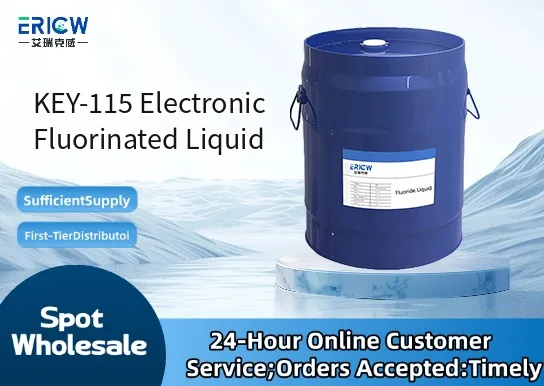
Non-conductive and electrically inert — safe for use in live electronic components and high-voltage environments.
Zero ozone depletion potential (ODP = 0) and ultra-low global warming potential (GWP < 10), compliant with evolving environmental regulations.
Fast-drying, residue-free evaporation at room temperature — eliminates post-cleaning drying steps.
Chemically stable with common metals, plastics, and elastomers — no swelling, cracking, or corrosion observed under standard operating conditions.
Low surface tension and excellent wettability — ensures thorough penetration into fine-pitch PCB assemblies and microelectromechanical systems (MEMS).
Critical cleaning of printed circuit boards (PCBs), solder paste residues, and flux contaminants prior to conformal coating.
Dielectric testing fluid for high-precision sensor calibration and insulation resistance verification.
Carrier solvent for precision deposition of functional nanomaterials in semiconductor packaging processes.
Final rinse medium in vapor phase degreasing systems for aerospace-grade avionics assemblies.
Thermal interface fluid for transient thermal management during burn-in and functional testing of power modules.
| Chemical Type | Perfluorinated polyether (PFPE) derivative |
| Product Form | Clear, colorless liquid |
| Appearance | Transparent, odorless, non-viscous |
| Melting Point | Below −60 °C (typical) |
| Boiling Point (at 760 mmHg) | 118–122 °C |
| Density (25 °C) | 1.72–1.76 g/cm³ |
| Dielectric Strength (ASTM D877) | ≥45 kV/mm (1 mm gap) |
| Regulatory Compliance | REACH SVHC-free; RoHS 2015/863 compliant; no listed TSCA or Prop 65 concerns |
| Common Compatible Systems | Suitability |
| Vapor Degreasing Equipment (e.g., Precision Cleaning Systems Inc. Model VDS-3000) | Highly Recommended – Optimized for full compatibility with condenser design and stainless-steel construction |
| Ultrasonic Cleaning Baths (Stainless Steel, 40–60 kHz) | Recommended – Requires temperature control ≤45 °C to maintain stability |
| Automated Spray-in-Air (SIA) Dispensing Systems | Suitable – Compatible with PTFE, FKM, and 316 stainless-steel wetted parts |
| Batch Immersion Tanks (Polypropylene or PVDF-lined) | Recommended – No degradation observed after 72-hour continuous contact |
Q1: What is the CAS Registry Number for KEY-115?
A: The CAS number for KEY-115 Electronic Fluorinated Liquid is 202905-28-6.
Q2: What is the recommended usage concentration for immersion cleaning?
A: KEY-115 is used neat (100% concentration); dilution is not required or recommended, as it is formulated for optimal performance in pure form.
Q3: How does KEY-115 compare to traditional chlorinated solvents like TCE or nPB?
A: Unlike TCE or nPB, KEY-115 contains no chlorine or bromine, eliminating toxic metabolite formation, carcinogenicity concerns, and ozone-depleting behavior — while delivering equivalent or superior cleaning efficacy on polar and non-polar residues.
Q4: Is KEY-115 subject to migration or leaching when used as a thermal interface material?
A: No measurable migration or extractables have been detected per IEC 60068-2-66 testing; its high molecular weight and low volatility ensure long-term positional stability under thermal cycling (−40 °C to +125 °C).
Q5: Does KEY-115 require special disposal handling?
A: KEY-115 is classified as non-hazardous for landfill disposal per EPA 40 CFR Part 261 (non-D-listed, non-P-listed); however, recycling via licensed fluorinated solvent reclamation is strongly encouraged.
Contact With Us:
E-mail: wangxingqiang@ericwchem.com
Have a Questions? Call Us:
Add:
Building A1, Jiete Industrial Park, Huangpu District, Guangzhou City, Guangdong Province, China