English
 Español
 tiếng việt
 русский
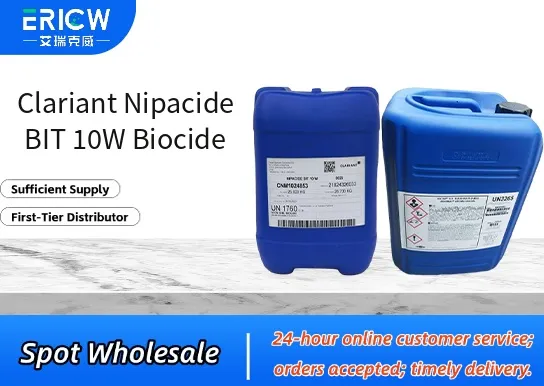
Broad-spectrum antimicrobial activity against bacteria, fungi, and algae.
Water-soluble liquid formulation for easy handling and uniform dispersion.
Stable across a wide pH range (pH 2–12), ensuring compatibility in diverse formulations.
Low volatility and minimal odor, enhancing workplace safety and user acceptance.
Compatible with common surfactants, thickeners, and other water-based additives.
Preservation of water-based paints and coatings.
Protection of architectural and industrial adhesives.
Microbial control in metalworking fluids.
Stabilization of construction chemicals including grouts and mortars.
Antimicrobial protection in household and industrial cleaning products.
| Chemical Type | 1,2-Benzisothiazolin-3-one (BIT) |
| Product Form | Aqueous solution |
| Appearance | Clear, pale yellow liquid |
| Active Ingredient Content | 10.0 ± 0.5 wt% BIT |
| pH (1% aqueous solution) | 6.0 – 8.0 |
| Density (20 °C) | 1.04 – 1.07 g/cm³ |
| Solubility | Completely miscible with water |
| Storage Stability | ≥ 24 months at 5–25 °C in original sealed container |
Q1: What is the active ingredient in Nipacide BIT 10W?
A: The active biocidal component is 1,2-benzisothiazolin-3-one (BIT), supplied as a stable 10% aqueous solution with proprietary stabilizers and surfactants to ensure compatibility and performance in water-based systems.
Q2: In which types of formulations is Nipacide BIT 10W commonly used?
A: It is widely applied in water-based industrial products such as paints and coatings, adhesives, sealants, construction chemicals, metalworking fluids, and household and institutional cleaning solutions—where broad-spectrum preservation against bacteria, yeasts, and molds is required.
Q3: How does pH affect the stability and efficacy of Nipacide BIT 10W?
A: BIT remains effective across a broad pH range, typically from approximately 4 to 10. However, prolonged exposure to highly alkaline conditions (pH > 10) may accelerate degradation, so formulation pH should be monitored and controlled during storage and use.
Q4: Is Nipacide BIT 10W compatible with common thickeners and surfactants?
A: Yes, it demonstrates good compatibility with many anionic, nonionic, and amphoteric surfactants, as well as associative and non-associative thickeners commonly used in architectural and industrial coatings—though compatibility testing under actual formulation conditions is always recommended.
Q5: What safety and handling precautions should be observed when using Nipacide BIT 10W?
A: As with all biocidal agents, appropriate personal protective equipment (PPE) including gloves and eye protection should be worn during handling. Avoid inhalation of mists or prolonged skin contact. Refer to the Safety Data Sheet (SDS) for detailed toxicological information, first-aid measures, and disposal guidance.
Contact With Us:
E-mail: wangxingqiang@ericwchem.com
Have a Questions? Call Us:
Add:
Building A1, Jiete Industrial Park, Huangpu District, Guangzhou City, Guangdong Province, China