English
 Español
 tiếng việt
 русский
High-gloss, durable finish with excellent flow and leveling characteristics.
Optimized for triglycidyl isocyanurate (TGIC)-free powder coating systems.
Excellent chemical resistance and long-term weatherability under UV exposure.
Consistent reactivity profile enabling reliable cure at standard industrial temperatures (180–200 °C).
Low melt viscosity supports high transfer efficiency and minimal film defects.
Architectural aluminum extrusions for façades and curtain walls.
Outdoor furniture and garden equipment coatings.
Agricultural and construction machinery components.
Heating, ventilation, and air conditioning (HVAC) enclosures.
| Chemical Type | Carboxyl-functional saturated polyester |
| Product Form | Free-flowing white to off-white granules |
| Appearance | Homogeneous granular solid |
| Acid Value (mg KOH/g) | 35–42 |
| Gardner Color | ≤ 2 |
| Melt Viscosity (cP, 200 °C) | 3,500–5,500 |
| Softening Point (°C, ASTM E28) | 78–85 |
| Primary Applications | TGIC-free architectural and industrial powder coatings |
Q1: What is the primary application of CRYLCOAT E 04329 in powder coatings?
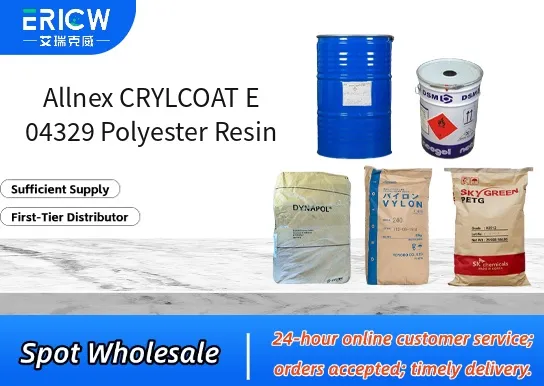
A: CRYLCOAT E 04329 is a carboxyl-functional polyester resin designed for use as a binder in TGIC-free and TGIC-containing thermosetting powder coatings, particularly for architectural and general-purpose indoor/outdoor applications requiring good flow, mechanical durability, and UV stability.
Q2: Is CRYLCOAT E 04329 compatible with common crosslinkers used in powder coatings?
A: Yes — it is formulated to react efficiently with standard crosslinkers including triglycidyl isocyanurate (TGIC), β-hydroxyalkyl amides (HAA), and glycidyl methacrylate (GMA)-functional acrylic co-resins, enabling flexible formulation options for different performance and regulatory requirements.
Q3: How does CRYLCOAT E 04329 perform in terms of weather resistance and gloss retention?
A: As a medium-to-high molecular weight polyester with optimized aromatic/aliphatic balance, it delivers robust exterior durability, including good resistance to chalking, fading, and gloss loss under accelerated and natural weathering conditions — especially when paired with high-quality pigments and UV stabilizers.
Q4: What are the recommended storage conditions to maintain resin integrity?
A: Store in original sealed containers in a cool, dry, and well-ventilated area away from direct sunlight, heat sources, and moisture. Prolonged exposure to elevated temperatures or humidity may affect viscosity, acid value stability, or reactivity over time.
Contact With Us:
E-mail: wangxingqiang@ericwchem.com
Have a Questions? Call Us:
Add:
Building A1, Jiete Industrial Park, Huangpu District, Guangzhou City, Guangdong Province, China