English
 Español
 tiếng việt
 русский
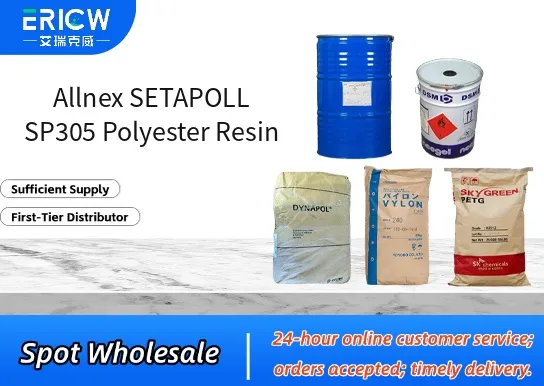
High-solids, low-viscosity unsaturated polyester resin for efficient processing and reduced VOC emissions.
Excellent compatibility with standard styrene monomers and common accelerators used in gel coats and laminating systems.
Superior surface hardness and gloss retention after curing, supporting high-end aesthetic requirements.
Good thixotropic response when formulated with fumed silica or modified clays, enabling sag-resistant vertical application.
Consistent batch-to-batch performance ensured by Allnex’s stringent quality control and ISO-certified manufacturing.
Gel coats for marine fiberglass hulls and decks requiring UV resistance and water impermeability.
Laminating resins for wind turbine blade skins and structural composites in renewable energy.
Reinforced thermoset parts in transportation (e.g., truck body panels, bus interiors).
Architectural precast and decorative concrete facades where dimensional stability and weatherability are critical.
Industrial tanks and corrosion-resistant linings for chemical containment systems.
| Chemical Type | Unsaturated polyester resin |
| Product Form | Liquid, ready-to-use |
| Appearance | Clear to pale yellow viscous liquid |
| Primary Applications | Gel coats, laminating, casting, and pultrusion |
| Key Features | High solids (>65%), low styrene demand, excellent flow and leveling |
| Benefits | Reduced emission profile, improved productivity, enhanced surface finish |
| Storage Stability | 12 months in original unopened container at 15–25°C |
| Recommended Catalyst | Methyl ethyl ketone peroxide (MEKP) at 0.8–1.5% w/w |
Q1: What is the primary function of SETAPOLL SP305 in coating formulations?
A: SETAPOLL SP305 is a low-viscosity, reactive polyester resin designed to act as a co-resin or crosslinking modifier—enhancing flexibility, impact resistance, and film formation in thermosetting powder and liquid coatings, particularly where balanced cure speed and mechanical performance are required.
Q2: Is SETAPOLL SP305 suitable for use in food-contact compliant coatings?
A: While SETAPOLL SP305 is not inherently certified for food contact, it may be incorporated into finished coating systems that are formulated and validated to meet applicable regulatory requirements—subject to full system testing and compliance verification by the end-user or formulator.
Q3: How does SETAPOLL SP305 compare to conventional glycidyl-functional acrylic resins in terms of reactivity and cure profile?
A: SETAPOLL SP305 exhibits moderate thermal reactivity with common curing agents (e.g., TGIC, HAA, or blocked isocyanates), offering a more gradual gelation onset than highly reactive acrylics—enabling improved flow and reduced edge pull in powder coatings without sacrificing final crosslink density.
Q4: Can SETAPOLL SP305 be used in UV-curable systems?
A: No—SETAPOLL SP305 is a thermally curable polyester resin and does not contain photoreactive groups; it is not compatible with UV-initiated polymerization mechanisms and should only be used in thermally cured or hybrid thermal/UV systems where its functionality is intentionally retained for co-crosslinking.
Contact With Us:
E-mail: wangxingqiang@ericwchem.com
Have a Questions? Call Us:
Add:
Building A1, Jiete Industrial Park, Huangpu District, Guangzhou City, Guangdong Province, China