English
 Español
 tiếng việt
 русский
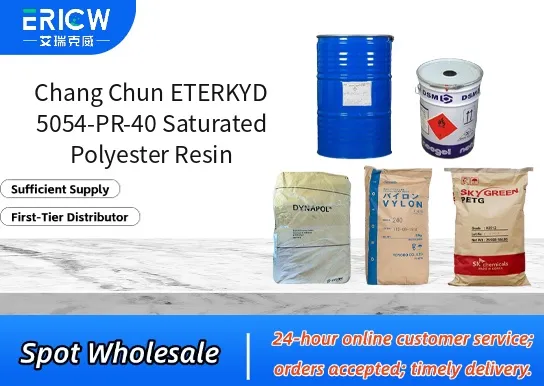
Excellent chemical resistance to solvents, acids, and alkalis in cured coatings.
High gloss retention and superior UV stability for long-term outdoor performance.
Low viscosity enables easy formulation with melamine crosslinkers and good spray application properties.
Consistent batch-to-batch reproducibility meeting stringent quality control standards.
Designed for high-solid, low-VOC coating systems compliant with modern environmental regulations.
Automotive OEM clearcoats and topcoats.
Industrial maintenance coatings for metal furniture and enclosures.
Prefinished building panels and architectural cladding systems.
Appliance coatings requiring durability and aesthetic consistency.
General-purpose coil coatings for pre-painted steel substrates.
| Chemical Type | Saturated polyester resin (melamine-curable) |
| Product Form | Liquid, solvent-based |
| Appearance | Clear to pale yellow transparent liquid |
| Non-Volatile Content (120°C, 60 min) | 58–62 wt% |
| Acid Value | 8–12 mg KOH/g |
| Hydroxyl Value | 130–150 mg KOH/g |
| Viscosity (25°C, Brookfield RV-DV-II+Pro, spindle #3, 20 rpm) | 4,500–6,500 cP |
| Primary Applications | High-performance thermosetting decorative and protective coatings |
Q1: What is the primary application field for ETERKYD 5054-PR-40?
A: ETERKYD 5054-PR-40 is specifically designed for high-performance coil coating systems, where excellent flow, leveling, and film integrity are required under rapid cure conditions.
Q2: How does this resin perform in terms of chemical resistance and outdoor durability?
A: As a saturated polyester with optimized backbone structure and crosslink density, it delivers robust resistance to humidity, alkalis, and common industrial cleaners, and supports long-term gloss retention and chalking resistance in exterior coil-coated applications.
Q3: Is ETERKYD 5054-PR-40 compatible with standard amino crosslinkers used in coil coatings?
A: Yes — it is formulated for compatibility with conventional melamine-formaldehyde resins and exhibits good reactivity under typical coil coating cure schedules (e.g., 230–260 °C, 20–60 seconds).
Q4: What viscosity range can be expected, and how does it affect formulation handling?
A: It is supplied as a medium-viscosity liquid resin, enabling straightforward incorporation into solvent-based or high-solids coil coating formulations without requiring excessive thinning or high-shear dispersion.
Q5: Does this resin support low-VOC or high-solids formulations?
A: Yes — its molecular design allows formulation flexibility for both conventional solvent-borne systems and higher-solids alternatives, supporting VOC reduction strategies without compromising film performance.
Contact With Us:
E-mail: wangxingqiang@ericwchem.com
Have a Questions? Call Us:
Add:
Building A1, Jiete Industrial Park, Huangpu District, Guangzhou City, Guangdong Province, China