English
 Español
 tiếng việt
 русский
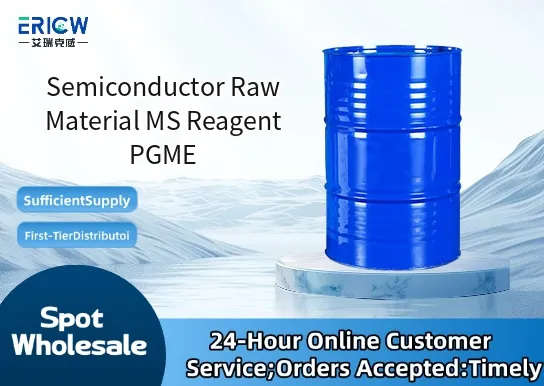
Ultra-high purity (≥99.999%): rigorously purified to meet semiconductor-grade contamination limits for trace metals (<10 ppt) and particulates.
Low volatility and controlled evaporation profile: enables precise, uniform film formation during spin-coating processes.
Excellent solvency for photoresist polymers: fully compatible with advanced chemically amplified resists (CARs) without inducing premature deprotection.
Non-reactive with silicon wafers and metal interconnect layers: prevents interfacial oxidation or corrosion during processing.
Stable shelf life under inert atmosphere: maintains specification integrity for ≥24 months when stored at 15–25°C in sealed amber HDPE containers.
Photoresist diluent and casting solvent in 193-nm and EUV lithography processes for logic and memory device fabrication.
Carrier solvent for resist formulation in high-volume semiconductor foundry production lines.
Post-application rinse medium for optimizing resist edge acuity and reducing standing wave effects.
Process-compatible cleaning agent for photomask and wafer track modules requiring low-residue, non-etching performance.
Component in multi-solvent blends for advanced patterning layers in 3D NAND and GAA-FET manufacturing.
| Chemical Type | Propylene Glycol Monomethyl Ether (PGME), C4H10O2 |
| Product Form | Liquid, clear and colorless |
| Appearance | Transparent, water-white liquid, free of suspended matter |
| Melting Point | −85 °C |
| Boiling Point (760 mmHg) | 121–122 °C |
| Primary Applications | Photoresist formulation, spin-coating solvent, post-apply rinse |
| Key Features | Low surface tension (26.5 mN/m at 20°C), high resist solubility, minimal residue after bake |
| Regulatory Compliance | REACH registered; RoHS 2015/863 compliant; no SVHCs above threshold |
| Common Compatible Systems | Suitability |
| TOK TOK PAK™ Resist Dispense Systems | Highly Recommended – Validated for full process integration with zero nozzle clogging |
| Canon FPA-1200NZ2C Litho Track Modules | Highly Recommended – Certified for use in coating, develop, and rinse sequences |
| ASML NXT:2000i Coater-Developer Tools | Recommended – Requires standard pre-filter (0.1 µm PTFE) and nitrogen purging |
| Screen SemiClean™ Solvent Recovery Units | Suitable – Compatible with distillation-based recycling protocols; >92% recovery yield |
Q1: What is the CAS Registry Number for Semiconductor Raw Material MS Reagent PGME?
A: The CAS number is 108-65-6, corresponding to analytical-grade Propylene Glycol Monomethyl Ether meeting SEMI S2-0220 purity requirements.
Q2: What is the recommended usage concentration when diluting photoresists?
A: Typical working concentrations range from 85–95 wt% PGME in resist formulations; exact ratios depend on polymer Tg and desired viscosity—refer to our Application Note AN-PGME-07 for litho-specific calibration curves.
Q3: How does MS Reagent PGME compare to technical-grade PGME in semiconductor applications?
A: Unlike technical-grade material, MS Reagent PGME undergoes dual-stage molecular distillation and sub-micron filtration, reducing Na/K/Ca/Fe contamination by >3 orders of magnitude and eliminating residual amines that cause resist poisoning.
Q4: Does this product comply with IEC 62474 VOC restrictions for semiconductor manufacturing?
A: Yes—PGME is explicitly listed as an exempted solvent under IEC 62474:2023 Annex A; it carries zero VOC classification per EPA Method 24 and EU Directive 2004/42/EC.
Q5: Is extractable migration into SiO2 or low-k dielectrics observed during post-exposure bake?
A: No measurable migration occurs under standard PEB conditions (110–130°C, 60 sec); FTIR-ATR and TOF-SIMS confirm <0.05 ng/cm² residual carbon at dielectric interfaces.
Contact With Us:
E-mail: wangxingqiang@ericwchem.com
Have a Questions? Call Us:
Add:
Building A1, Jiete Industrial Park, Huangpu District, Guangzhou City, Guangdong Province, China