English
 Español
 tiếng việt
 русский
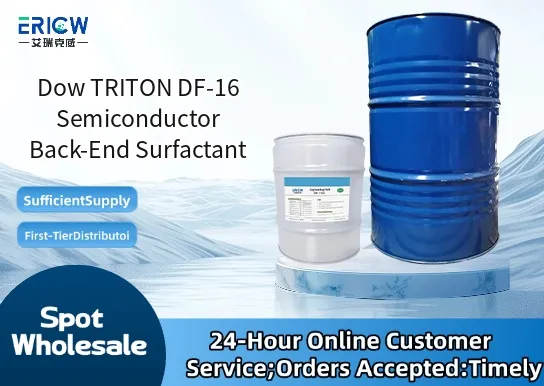
Engineered specifically for post-CMP (Chemical Mechanical Planarization) cleaning in advanced semiconductor back-end-of-line (BEOL) processes.
Low-residue, non-ionic surfactant formulation designed to minimize metal contamination and particle redeposition on Cu/low-k interconnect structures.
Excellent wetting and penetrating capability for sub-20 nm feature geometries without compromising dielectric integrity.
Compatible with ultra-low surface tension rinse chemistries and optimized for megasonic-assisted cleaning systems.
Stable across a broad pH range (4–9) and compatible with deionized water-based process streams.
Cu/low-k BEOL cleaning after CMP of copper interconnects and barrier layers.
Rinse aid in wafer-level packaging (WLP) and fan-out wafer-level packaging (FOWLP) cleaning steps.
Residue removal in post-etch and post-ash cleaning for 28 nm and below logic/foundry nodes.
Surface energy modification for improved uniformity in spin-rinse-dry (SRD) processes.
Enhancing removal efficiency of organic residues in dual-damascene structure cleaning.
| Chemical Type | Non-ionic alkylphenol ethoxylate derivative (APE-free) |
| Product Form | Clear, pale yellow liquid |
| Appearance | Homogeneous, free of visible particulates or phase separation |
| Active Content (w/w %) | 98.5–100.0% |
| pH (1% aqueous solution, 25°C) | 6.0–7.5 |
| Primary Applications | Post-CMP cleaning, BEOL residue removal, low-k compatible rinsing |
| Key Features | Ultra-low ionic impurity profile, high hydrolytic stability, low foaming |
| Regulatory Compliance | REACH registered; RoHS compliant; no SVHCs above threshold per current Annex XIV |
| Common Compatible Systems | Suitability |
| Megasonic cleaning tools (e.g., SCREEN, Lam Research, Tokyo Electron) | Highly Recommended – Validated for >99.9% particle removal at 15–30 kHz frequencies |
| Spin-rinse-dry (SRD) modules with DI water recirculation | Highly Recommended – No nozzle clogging or film formation observed after 500+ wafers |
| Low-k dielectric-compatible cleaning chemistries (e.g., dilute SC1 variants) | Recommended – Synergistic performance when blended at ≤0.1 wt% concentration |
| Single-wafer processing platforms with temperature-controlled dispense | Suitable – Stable up to 60°C; no degradation or precipitation observed |
Q1: What is the CAS Registry Number for Dow TRITON DF-16?
A: The CAS number for Dow TRITON DF-16 is 1339781-92-1. This identifier corresponds specifically to the purified, semiconductor-grade composition.
Q2: What is the recommended usage concentration in BEOL cleaning formulations?
A: Typical dosage ranges from 0.02 to 0.08 wt% in DI water-based rinse solutions; optimal concentration is determined via particle count testing at target node-specific geometry and tool configuration.
Q3: How does TRITON DF-16 differ from legacy TRITON X-100 or DF-10 in semiconductor applications?
A: Unlike TRITON X-100 (which contains APEs and higher sodium content), DF-16 is APE-free, exhibits lower metallic impurities (<10 ppt Na, K, Ca), and demonstrates superior compatibility with porous low-k dielectrics (k < 2.7) and Cu surfaces.
Q4: Is TRITON DF-16 subject to leaching or extractables in high-purity rinse environments?
A: Extractables testing per SEMI F57 shows total organic carbon (TOC) contribution < 0.5 ppb after standard DI rinse cycles; no detectable migration into photoresist or ILD layers under validated process conditions.
Q5: Does TRITON DF-16 require special handling or storage conditions?
A: Store in original sealed container at 10–30°C, protected from direct sunlight; avoid freezing. No special ventilation required, but use in ISO Class 5 or cleaner environments for semiconductor-grade handling.
Contact With Us:
E-mail: wangxingqiang@ericwchem.com
Have a Questions? Call Us:
Add:
Building A1, Jiete Industrial Park, Huangpu District, Guangzhou City, Guangdong Province, China