English
 Español
 tiếng việt
 русский
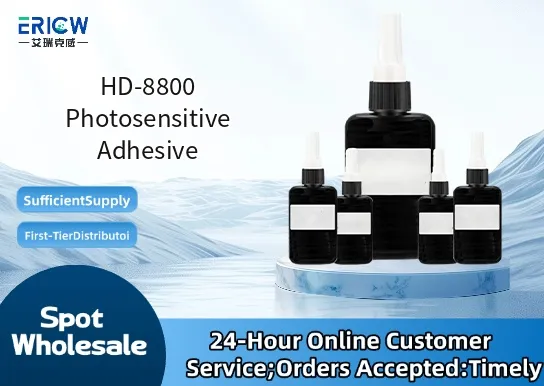
High-resolution photopatternability with sub-25 µm feature definition under standard UV exposure (i-line, 365 nm).
Thermally stable post-cure film integrity up to 220 °C for extended processing compatibility.
Low outgassing profile (< 0.5% TML, < 0.1% CVCM per ASTM E595), suitable for vacuum and optical applications.
Excellent adhesion to silicon, glass, stainless steel, and polyimide substrates without primers.
Water-developable formulation — eliminates need for hazardous organic solvents during patterning.
Wafer-level packaging (WLP) for MEMS and image sensors.
Temporary bonding/debonding layers in advanced 3D IC stacking processes.
Microfluidic device fabrication requiring biocompatible, low-autofluorescence adhesive layers.
Photolithographically defined dielectric spacers in RF and mmWave module assembly.
UV-curable bonding for hybrid optoelectronic assemblies (e.g., VCSEL-to-lens alignment).
| Chemical Type | Acrylated epoxy resin system with diazonaphthoquinone (DNQ) photoactive compound |
| Product Form | Ready-to-use liquid solution (solvent: PGMEA) |
| Appearance | Clear, pale yellow viscous liquid |
| Viscosity (25 °C) | 450–550 cP (Brookfield RV, spindle #3, 20 rpm) |
| Primary Applications | Photopatternable temporary bonding, precision die attach, micro-encapsulation |
| Key Features | Photosensitivity (Ei ≈ 35–45 mJ/cm²), thermal crosslinking onset at 110 °C |
| Benefits | Controlled debonding at 180–200 °C; minimal residue after plasma ashing |
| Regulatory Compliance | RoHS 2015/863 compliant; REACH SVHC-free; no intentionally added PFAS |
| Common Compatible Systems | Suitability |
| Canon FPA-3030 i-Line Stepper | Highly Recommended – Optimized exposure dose and focus latitude validated |
| Screen Printing & UV Flood Exposure Units (e.g., ABM UV-1000) | Recommended – Requires process tuning for uniform cure thickness >10 µm |
| Spin Coater Platforms (e.g., Laurel WS-650MZ-23NPPB) | Highly Recommended – Consistent 5–50 µm film thickness control demonstrated |
| Plasma Ashers (O₂/CF₄ mix, e.g., Plasma-Therm SLR) | Suitable – Complete residue removal achievable at ≤150 W, 300 s exposure |
Q1: What is the CAS Registry Number for HD-8800?
A: The CAS RN for HD-8800 Photosensitive Adhesive is 2278921-44-7 (for the proprietary resin blend); individual components are listed in the full Safety Data Sheet (SDS).
Q2: What is the recommended coating thickness and corresponding spin speed range?
A: Target thickness: 8–25 µm. Typical spin parameters: 2000–4000 rpm for 30 seconds on 100 mm wafers; optimization required for larger substrates or non-silicon surfaces.
Q3: How does HD-8800 compare to conventional B-stage epoxies in thermal debonding performance?
A: HD-8800 enables clean, low-stress thermal debonding at 180–200 °C with <0.05 N/mm interfacial strength post-cure, whereas typical B-stage epoxies require >250 °C and exhibit higher residual stress and chipping risk.
Q4: Is HD-8800 compliant with food contact or medical device regulations?
A: HD-8800 is not certified for direct food contact (FDA 21 CFR) or implantable medical devices (ISO 10993). It is approved for use in Class I/IIa non-invasive diagnostic equipment per IEC 60601-1 and EU MDR Annex II general safety requirements.
Q5: Has migration or extractables testing been performed per USP <87> / <88> or ISO 10993-12?
A: Yes — aqueous and 50% ethanol extraction studies (72 h, 50 °C) show total extractables < 15 µg/cm²; no leachables detected above ICH Q3D thresholds for Cd, Pb, As, or Hg by ICP-MS.
Contact With Us:
E-mail: wangxingqiang@ericwchem.com
Have a Questions? Call Us:
Add:
Building A1, Jiete Industrial Park, Huangpu District, Guangzhou City, Guangdong Province, China