English
 Español
 tiếng việt
 русский
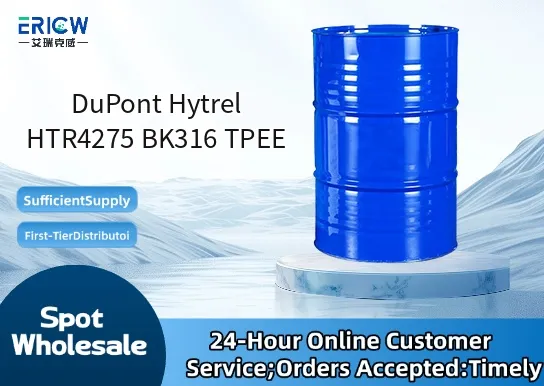
High heat resistance with continuous use temperature up to 150 °C (302 °F).
Excellent dynamic fatigue resistance for demanding cyclic loading applications.
Good chemical resistance to oils, greases, and many automotive fluids.
Outstanding melt processability via injection molding and extrusion.
Black colorant (BK316) pre-compounded for consistent aesthetics and UV stability.
Under-hood automotive components including air ducts and sensor housings.
Industrial power transmission belts and timing belt covers.
High-performance fluid handling connectors and seals in hydraulic systems.
Robust consumer appliance parts requiring thermal and mechanical durability.
| Chemical Type | Thermoplastic Polyester Elastomer (TPEE) |
| Product Form | Pellets |
| Appearance | Black, free-flowing pellets |
| Primary Applications | Under-hood automotive, industrial power transmission, fluid system components |
| Key Features | High heat resistance, dynamic fatigue performance, oil/chemical resistance |
| Benefits | Extended service life at elevated temperatures; reliable dimensional stability under load |
| Processing Methods | Injection molding, extrusion |
Q1: What distinguishes Hytrel HTR4275 BK316 from other TPEE grades in the Hytrel portfolio?
A: Hytrel HTR4275 BK316 is a black-pigmented, high-temperature resistant thermoplastic elastomer engineered for enhanced thermal stability and long-term mechanical performance under elevated service temperatures. It features a balanced combination of melt processability, tensile resilience, and resistance to dynamic fatigue—making it particularly suited for demanding automotive and industrial applications where standard TPEEs may exhibit reduced retention of properties.
Q2: Is Hytrel HTR4275 BK316 suitable for injection molding and extrusion processes?
A: Yes—HTR4275 BK316 is specifically formulated for robust processing via conventional thermoplastic methods including injection molding, extrusion, and two-shot molding. Its optimized melt viscosity and narrow molecular weight distribution support consistent flow, good surface finish, and minimal warpage, even in complex geometries and thin-walled parts.
Q3: How does the black pigment (BK316) affect UV resistance and weathering performance?
A: The integrated carbon-black-based pigment system significantly enhances UV stability and outdoor durability. Unlike unpigmented or lightly stabilized TPEEs, HTR4275 BK316 demonstrates improved resistance to photodegradation and surface embrittlement when exposed to sunlight and ambient weathering conditions—commonly required for exterior automotive trim and industrial housings.
Q4: Can Hytrel HTR4275 BK316 be overmolded onto common engineering plastics like PBT or PC?
A: Yes—it exhibits excellent adhesion to several polar engineering thermoplastics—including PBT, PET, and certain polycarbonate blends—when processed under appropriate mold temperature, melt temperature, and interfacial residence time conditions. Bond strength and interfacial integrity are further enhanced by proper substrate drying and surface compatibility assessment during development.
Contact With Us:
E-mail: wangxingqiang@ericwchem.com
Have a Questions? Call Us:
Add:
Building A1, Jiete Industrial Park, Huangpu District, Guangzhou City, Guangdong Province, China