English
 Español
 tiếng việt
 русский
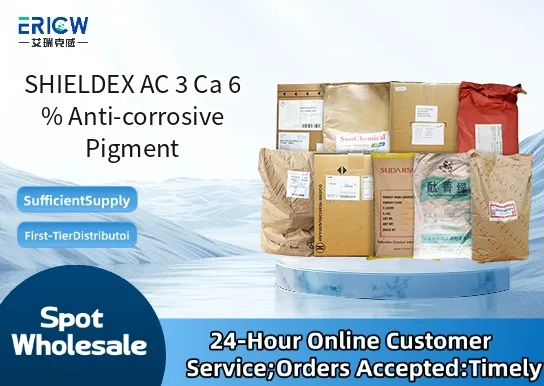
Calcium-modified phosphate-based anti-corrosive pigment offering active passivation of steel substrates.
Low-VOC, heavy-metal-free formulation compliant with modern environmental and regulatory standards.
Excellent dispersion stability in waterborne and solventborne epoxy, alkyd, and acrylic primers.
Enhances long-term barrier protection without compromising film integrity or adhesion.
Optimized particle size distribution for uniform pigment distribution and improved coating homogeneity.
Marine and offshore structural coatings for hulls, decks, and ballast tanks.
Industrial maintenance coatings for steel bridges, pipelines, and storage tanks.
Railway vehicle underbody and chassis primers.
Heavy-duty equipment and agricultural machinery protective coatings.
Architectural steel structures requiring durable, low-toxicity corrosion protection.
| Chemical Type | Calcium-modified amorphous phosphate |
| Product Form | Fine dry powder |
| Appearance | Off-white to light gray free-flowing powder |
| Calcium Content (as CaO) | Approx. 6% w/w |
| Bulk Density | 0.8–1.0 g/cm³ |
| pH (10% aqueous suspension) | 7.5–9.0 |
| Moisture Content | ≤ 1.5% (by weight) |
| Primary Applications | Anti-corrosive primers for ferrous metals |
Q1: What is the primary corrosion inhibition mechanism of SHIELDEX AC 3 Ca 6%?
A: SHIELDEX AC 3 Ca 6% functions primarily through passive film formation on metal substrates, leveraging calcium-modified active components to enhance interfacial stability and suppress anodic dissolution in aqueous and mildly aggressive environments.
Q2: Is SHIELDEX AC 3 Ca 6% compatible with water-based coatings and high-solids solventborne systems?
A: Yes — it is formulated for broad compatibility across waterborne acrylics, epoxies, and alkyds, as well as medium- to high-solids solventborne systems. Dispersibility and stability should be verified during formulation development, particularly in low-pH or highly polar media.
Q3: How does the 6% calcium content influence performance compared to non-calcium anti-corrosive pigments?
A: The controlled calcium incorporation improves buffering capacity at the metal-coating interface and supports more consistent passivation under fluctuating pH or humidity conditions, offering enhanced long-term protection in cyclic corrosion tests without compromising compatibility.
Q4: What is the recommended approach for dispersion and stabilization in coating formulations?
A: Optimal performance is achieved using high-shear dispersion followed by stabilization with suitable wetting and dispersing agents. Pre-dispersion in a portion of the vehicle phase prior to full formulation integration is strongly advised to ensure uniform distribution and minimize agglomeration.
Contact With Us:
E-mail: wangxingqiang@ericwchem.com
Have a Questions? Call Us:
Add:
Building A1, Jiete Industrial Park, Huangpu District, Guangzhou City, Guangdong Province, China