English
 Español
 tiếng việt
 русский
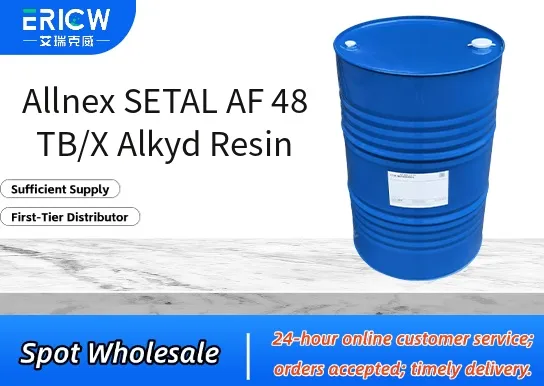
Medium-oil, phthalic anhydride-modified alkyd resin offering balanced drying speed and film flexibility.
Excellent compatibility with nitrocellulose, PVC plastisols, and common solvent-based acrylics.
Provides good gloss retention and surface hardness in air-dry coatings.
Low viscosity enables high-solids formulation without excessive solvent demand.
Designed for enhanced pigment wetting and improved rheological stability in industrial finishes.
Industrial maintenance coatings for metal structures and equipment.
General-purpose air-dry enamels for agricultural and construction machinery.
Undercoat primers requiring good sandability and intercoat adhesion.
Decorative wood finishes where moderate chemical resistance and flow leveling are required.
Coating systems for metal packaging and coil coating pre-treatment layers.
| Chemical Type | Phthalic anhydride-modified medium-oil alkyd resin |
| Product Form | Liquid |
| Appearance | Clear to slightly hazy amber liquid |
| Solvent | Xylene / aromatic hydrocarbon blend |
| Non-Volatile Content (wt%) | ~60–65% |
| Viscosity (25°C, mPa·s) | 1,200–1,800 (Brookfield LV, spindle #3, 6 rpm) |
| Acid Value (mg KOH/g) | 6–10 |
| Density (20°C, g/cm³) | 0.98–1.02 |
Q1: What is the primary function of SETAL AF 48 TB/X in alkyd-based coatings?
A: SETAL AF 48 TB/X is a modified alkyd resin designed to enhance film formation, improve substrate wetting, and promote leveling in solventborne decorative and industrial alkyd systems—particularly where improved flow and reduced surface defects are required.
Q2: Is SETAL AF 48 TB/X compatible with conventional long-oil alkyds and common co-solvents?
A: Yes, it demonstrates good compatibility with standard long- and medium-oil alkyd resins, as well as typical solvents used in alkyd formulations—including aromatic hydrocarbons, esters, and ketones—without risk of haze or phase separation under normal processing conditions.
Q3: Can SETAL AF 48 TB/X be used in air-drying versus forced-dry systems?
A: It is formulated for use in both ambient-cure and forced-dry alkyd systems. Its reactivity supports efficient oxidative crosslinking at room temperature while remaining responsive to thermal acceleration in stoving applications.
Q4: How does SETAL AF 48 TB/X influence gloss and hardness development?
A: It contributes to improved gloss retention and supports balanced hardness build during cure—enhancing early hardness without compromising flexibility or intercoat adhesion in multi-layer systems.
Contact With Us:
E-mail: wangxingqiang@ericwchem.com
Have a Questions? Call Us:
Add:
Building A1, Jiete Industrial Park, Huangpu District, Guangzhou City, Guangdong Province, China