English
 Español
 tiếng việt
 русский
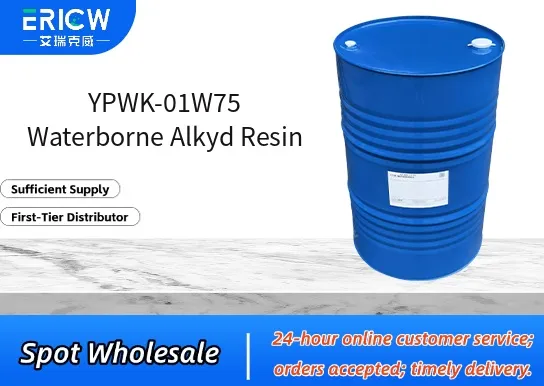
Low-VOC formulation compliant with global environmental regulations including EPA and EU REACH.
Excellent film hardness and flexibility balance after ambient or low-bake curing.
Superior water dilutability without co-solvents, enabling easy handling and reduced formulation complexity.
Good hydrolytic stability in neutral to mildly alkaline aqueous systems (pH 7.5–8.5).
Enhanced compatibility with acrylic emulsions, polyurethane dispersions, and common crosslinkers (e.g., melamine formaldehyde).
Architectural interior wall paints requiring durable, washable finishes.
Industrial maintenance coatings for metal substrates in mild-corrosion environments.
Wood finishing coatings for furniture and cabinetry with low-odor, fast-drying properties.
Waterborne can coatings for non-food-contact metal packaging.
Hybrid decorative topcoats combining alkyd aesthetics with water-based application safety.
| Chemical Type | Water-reducible alkyd resin (soy oil-modified) |
| Product Form | Aqueous dispersion (non-ionic stabilized) |
| Appearance | Translucent, pale yellow liquid |
| Solids Content (wt%) | 45 ± 1% |
| pH (25°C) | 7.8–8.2 |
| Viscosity (Brookfield RVT, spindle #3, 20 rpm, 25°C) | 150–300 mPa·s |
| Minimum Film Formation Temperature (MFFT) | 12–15°C |
| Storage Stability (25°C) | ≥6 months in sealed container |
Q1: What are the primary advantages of YPWK-01W75 compared to traditional solvent-based alkyd resins?
A: YPWK-01W75 offers significantly reduced VOC content while retaining the familiar handling, film formation, and aesthetic properties of conventional alkyds—such as excellent gloss development, substrate wetting, and compatibility with common coalescing agents and crosslinkers.
Q2: Is YPWK-01W75 compatible with acrylic emulsions and other waterborne binders?
A: Yes—it is specifically designed for good physical and chemical compatibility with a broad range of waterborne systems, including acrylic, vinyl acetate copolymer, and polyurethane dispersions, enabling hybrid formulations with balanced performance attributes.
Q3: How should YPWK-01W75 be incorporated into a waterborne coating formulation?
A: It is typically added during the let-down stage under moderate agitation. Pre-dilution with deionized water or a compatible co-solvent may improve dispersion stability. Avoid high-shear mixing after addition of associative thickeners or sensitive rheology modifiers.
Q4: Does YPWK-01W75 require post-addition of catalysts or curing agents for ambient cure?
A: No—YPWK-01W75 is an air-drying resin that undergoes oxidative crosslinking at ambient conditions. However, drying speed and final film hardness can be enhanced by incorporating small amounts of drier catalysts (e.g., cobalt-free alternatives) if required by application demands.
Contact With Us:
E-mail: wangxingqiang@ericwchem.com
Have a Questions? Call Us:
Add:
Building A1, Jiete Industrial Park, Huangpu District, Guangzhou City, Guangdong Province, China