English
 Español
 tiếng việt
 русский
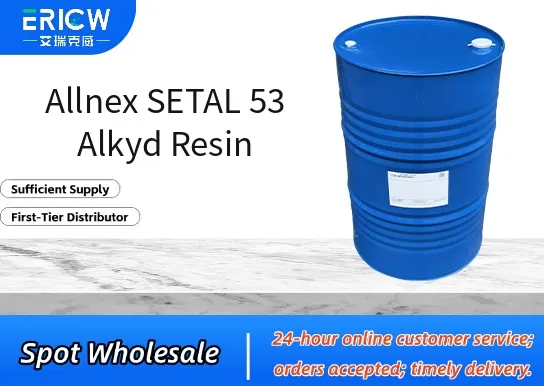
Medium-oil-length alkyd resin offering balanced drying speed and film flexibility.
Excellent compatibility with nitrocellulose, acrylics, and other common coating resins.
Provides good gloss retention and weather resistance in air-dry formulations.
Low viscosity enables high-solids formulation without sacrificing application performance.
Consistent batch-to-batch quality supported by Allnex’s global manufacturing standards.
General-purpose industrial maintenance coatings.
Wood finishes for furniture and cabinetry.
Automotive refinish primers and basecoats.
Architectural metal coatings for exterior applications.
Printing ink vehicles requiring fast air-dry response.
| Chemical Type | Medium-oil-length alkyd resin (soya oil modified) |
| Product Form | Liquid solution in aromatic hydrocarbons (e.g., xylene) |
| Appearance | Clear, pale yellow to amber viscous liquid |
| Non-Volatile Content (wt%) | ~60–65% |
| Gardner Color | ≤ 8 |
| Acid Value (mg KOH/g) | 6–10 |
| Viscosity (mPa·s at 25°C) | 4,000–7,000 |
| Primary Applications | Industrial coatings, wood finishes, automotive refinish |
Q1: What is the primary function of SETAL 53 in coating formulations?
A: SETAL 53 is a medium-oil-length alkyd resin designed to serve as a film-forming binder in solventborne decorative and industrial maintenance coatings. It contributes good gloss retention, flexibility, and through-dry performance while enabling compatibility with common co-resins and crosslinkers.
Q2: Is SETAL 53 suitable for high-solids or low-VOC formulations?
A: Yes — SETAL 53 offers favorable viscosity-to-solids ratio and can be formulated into medium- to high-solids systems. Its molecular structure supports VOC reduction strategies when combined with appropriate solvents and rheology modifiers, though final compliance depends on the full formulation matrix.
Q3: How does SETAL 53 perform in terms of yellowing resistance?
A: As a cobalt-free, non-yellowing alkyd resin, SETAL 53 exhibits improved resistance to yellowing upon aging and UV exposure compared to traditional cobalt-catalyzed alkyds. This makes it especially suitable for light-colored and white topcoats where long-term color stability is critical.
Q4: Can SETAL 53 be used in combination with acrylic or polyester resins?
A: Yes — SETAL 53 demonstrates broad compatibility with many acrylic, polyester, and amino resins. Blending is commonly employed to balance cost, drying speed, hardness, and flexibility. Compatibility testing under intended processing and curing conditions is recommended to confirm phase stability and film integrity.
Contact With Us:
E-mail: wangxingqiang@ericwchem.com
Have a Questions? Call Us:
Add:
Building A1, Jiete Industrial Park, Huangpu District, Guangzhou City, Guangdong Province, China