English
 Español
 tiếng việt
 русский
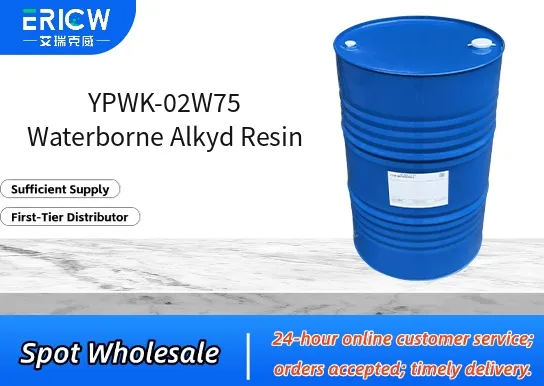
Low-VOC formulation compliant with global environmental regulations including EPA and EU REACH.
Excellent film hardness and scratch resistance after ambient cure.
Superior water dilutability without co-solvents, enabling easy handling and reduced formulation complexity.
Good compatibility with acrylic emulsions and other waterborne resins for hybrid systems.
Enhanced yellowing resistance versus conventional alkyds, ideal for white and pastel coatings.
Interior architectural wall paints requiring durable, washable finishes.
Waterborne wood primers and topcoats for furniture and cabinetry.
Industrial maintenance coatings for metal substrates in mild environments.
Refinish coatings for automotive interior trim and non-underhood components.
Eco-friendly decorative coatings for children’s products and educational facilities.
| Chemical Type | Water-reducible alkyd resin (soy oil-modified) |
| Product Form | Opaque white to light yellow liquid dispersion |
| Appearance | Homogeneous, low-viscosity aqueous dispersion |
| Solids Content (wt%) | 42 ± 1% |
| pH (25°C) | 8.2 – 8.8 |
| Viscosity (DIN4, 25°C) | 80 – 120 mPa·s |
| Minimum Film Formation Temperature (MFFT) | 12 – 15°C |
| Storage Stability (25°C) | ≥6 months in sealed container |
Q1: What are the key advantages of YPWK-02W75 compared to traditional solvent-based alkyd resins?
A: YPWK-02W75 offers significantly reduced VOC content while retaining the familiar handling, film formation, and gloss development characteristics of conventional alkyds. It enables formulators to meet increasingly stringent environmental regulations without major reformulation efforts or compromises in final film performance.
Q2: Is YPWK-02W75 compatible with common waterborne acrylic or polyurethane dispersions?
A: Yes, YPWK-02W75 is designed for broad compatibility in hybrid waterborne systems. It can be successfully blended with many acrylic and anionic or nonionic polyurethane dispersions to enhance hardness development, substrate wetting, and recoatability—though compatibility testing under specific formulation conditions is recommended prior to full-scale production.
Q3: How should YPWK-02W75 be incorporated into a waterborne coating formulation?
A: It is typically added during the let-down stage, after pigment grinding, under moderate agitation. Avoid high-shear mixing at this stage to prevent viscosity instability. pH adjustment may be required depending on the overall system; optimal performance is generally achieved within a pH range of 7.5–9.0.
Q4: Does YPWK-02W75 require coalescing agents or other film-forming aids?
A: Due to its self-crosslinking capability and optimized particle morphology, YPWK-02W75 generally achieves good film formation at ambient temperatures without additional coalescents. However, in low-temperature or high-humidity application environments, minor adjustments with standard waterborne coalescing agents may further improve early film integrity.
Contact With Us:
E-mail: wangxingqiang@ericwchem.com
Have a Questions? Call Us:
Add:
Building A1, Jiete Industrial Park, Huangpu District, Guangzhou City, Guangdong Province, China