English
 Español
 tiếng việt
 русский
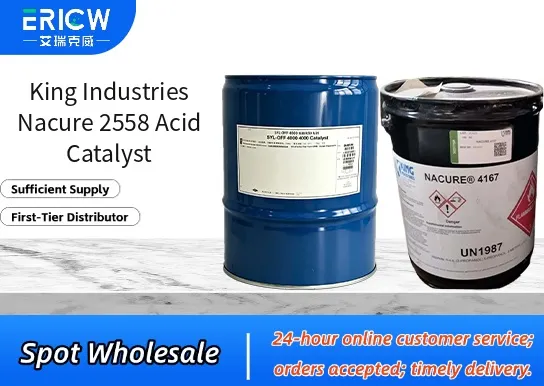
Highly effective low-temperature curing accelerator for amino-formaldehyde resins.
Provides excellent shelf stability in water-based and solvent-borne systems.
Delivers consistent cure performance with minimal volatility and odor.
Compatible with melamine, urea, and phenolic resin formulations.
Enables reduced oven dwell times and lower energy consumption in industrial curing processes.
Automotive coil coatings requiring rapid through-cure and edge coverage.
Industrial wood finishes for medium-density fiberboard (MDF) and particleboard.
Powder coating formulations based on melamine-cured polyester resins.
Can coatings for food and beverage containers requiring FDA-compliant cure profiles.
Electrical laminates and decorative high-pressure laminates (HPL).
| Chemical Type | Sulfonic acid-based catalyst (non-volatile, latent) |
| Product Form | Free-flowing white to off-white crystalline powder |
| Appearance | Crystalline solid, free of visible impurities |
| Primary Applications | Crosslinking catalyst for amino resins in thermoset coatings and laminates |
| Key Features | Latent activation, pH-triggered release, low dust generation |
| Storage Stability | Stable for ≥12 months at 25°C in sealed container |
| Solubility | Readily soluble in water, alcohols, glycol ethers, and common organic solvents |
| Handling | Non-corrosive to mild steel; recommended for use under standard industrial hygiene practices |
Q1: What is the primary function of Nacure 2558 in coating and ink formulations?
A: Nacure 2558 is a latent acid catalyst designed to promote efficient crosslinking of melamine-formaldehyde and other amino resins at elevated temperatures. It remains inactive at ambient conditions, enabling extended pot life and improved formulation stability prior to cure.
Q2: How does Nacure 2558 compare to traditional strong acid catalysts in terms of handling and safety?
A: Unlike highly corrosive liquid acids (e.g., p-toluenesulfonic acid), Nacure 2558 is supplied as a free-flowing solid with lower volatility and reduced handling hazards. It offers improved worker safety, easier metering, and less risk of premature resin degradation during storage or mixing.
Q3: Is Nacure 2558 compatible with waterborne systems?
A: Yes — Nacure 2558 exhibits good compatibility with many waterborne acrylic and polyester dispersions, provided pH and ionic environment are controlled. Its low water solubility helps minimize hydrolysis-related instability while still delivering effective thermal activation.
Q4: What is the typical activation temperature range for full catalytic activity?
A: Full catalytic activity generally begins above 120 °C and increases progressively through the standard baking range of 140–180 °C. Optimal cure performance is achieved within this window, depending on time, film thickness, and resin reactivity.
Q5: How should Nacure 2558 be incorporated into a formulation?
A: It is typically added during the let-down stage under moderate agitation. Pre-dispersion in a small portion of solvent or resin may aid uniform distribution. Dosage depends on formulation requirements but generally ranges from 0.1% to 2% by weight relative to total resin solids.
Contact With Us:
E-mail: wangxingqiang@ericwchem.com
Have a Questions? Call Us:
Add:
Building A1, Jiete Industrial Park, Huangpu District, Guangzhou City, Guangdong Province, China