English
 Español
 tiếng việt
 русский
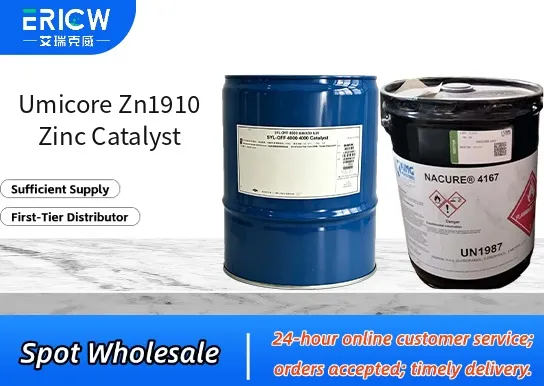
Highly selective zinc-based catalyst optimized for condensation and cyclization reactions.
Thermally stable up to 250 °C, enabling robust performance in continuous industrial processes.
Low heavy metal impurity profile, meeting stringent regulatory requirements for pharmaceutical intermediates.
Consistent batch-to-batch reproducibility ensured by Umicore’s certified GMP-compliant manufacturing.
Free-flowing granular form facilitating easy handling, dosing, and integration into existing reactor systems.
Synthesis of heterocyclic compounds including benzothiazoles and quinazolines.
Catalysis in the production of agrochemical active ingredients (e.g., fungicides and plant growth regulators).
Key catalyst in fine chemical routes for fragrances and specialty dyes.
Enabling step-efficient C–N and C–O bond formation in API manufacturing under mild conditions.
| Chemical Type | Zinc oxide-based heterogeneous catalyst with proprietary surface modification |
| Product Form | Free-flowing granules |
| Appearance | Off-white to light yellow granules |
| Zinc Content (as ZnO) | ≥ 85 wt% |
| Loss on Drying (105 °C, 2 h) | ≤ 1.5 wt% |
| Particle Size Distribution | D50: 250–350 µm |
| Primary Applications | Heterocycle synthesis, agrochemical intermediates, pharmaceutical catalysis |
| Key Features | High selectivity, thermal stability, low leaching, GMP-manufactured |
Q1: What is the primary function of Umicore Zn1910 in polymer synthesis?
A: Umicore Zn1910 is a zinc-based catalyst designed to promote condensation reactions—particularly in the production of polyesters and polyurethanes—by facilitating esterification and transesterification while offering improved selectivity and reduced side reactions compared to traditional metal soaps.
Q2: How does Zn1910 compare to conventional zinc oxide or zinc stearate catalysts?
A: Zn1910 features a tailored surface chemistry and controlled particle morphology that enhances dispersion in molten polymer systems and improves catalytic efficiency at lower dosages. It generally offers better thermal stability during processing and reduced risk of gel formation versus standard zinc compounds.
Q3: Is Zn1910 suitable for food-contact or medical-grade polymer applications?
A: While Zn1910 is formulated to meet high-purity expectations for technical polymers, its suitability for regulated applications depends on full formulation assessment and compliance verification by the end-user. It is not pre-approved for food contact or medical use; customers must conduct appropriate regulatory evaluation based on final product requirements and applicable regional frameworks.
Q4: What are the recommended handling and storage conditions?
A: Store Zn1910 in its original sealed container under dry, cool conditions (below 30 °C) and protect from moisture and direct sunlight. Avoid exposure to strong oxidizing agents. Standard industrial hygiene practices—including dust control and use of appropriate PPE during handling—are recommended due to its fine particulate nature.
Contact With Us:
E-mail: wangxingqiang@ericwchem.com
Have a Questions? Call Us:
Add:
Building A1, Jiete Industrial Park, Huangpu District, Guangzhou City, Guangdong Province, China