English
 Español
 tiếng việt
 русский
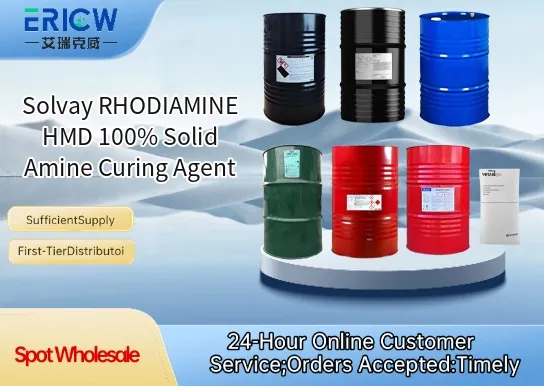
High-purity, 100% solid hexamethylenediamine (HMD) derivative offering precise stoichiometric control in epoxy formulations.
Low volatility and negligible vapor pressure ensure safe handling and reduced workplace exposure versus liquid amines.
Excellent reactivity with standard epoxy resins at elevated temperatures, enabling efficient crosslinking and rapid gelation.
Provides superior thermal stability and chemical resistance in cured thermoset networks.
Free-flowing crystalline powder with consistent particle size distribution for reliable metering and dry blending.
Aerospace composite matrices requiring high glass transition temperature (Tg) and low outgassing.
Electrical encapsulation and potting compounds for high-voltage insulation systems.
High-performance adhesives used in structural bonding of metals and composites.
Advanced wind turbine blade resin systems demanding extended pot life and post-cure performance.
Tooling and mold-making materials where dimensional stability and low shrinkage are critical.
| Chemical Type | Aliphatic diamine (hexamethylenediamine-based solid curing agent) |
| Product Form | Free-flowing crystalline powder |
| Appearance | White to off-white granular solid |
| Primary Applications | Epoxy resin curing for high-performance composites and electrical insulation |
| Key Features | 100% active content, low volatility, high thermal stability |
| Recommended Storage | Under inert atmosphere, cool and dry conditions (≤25°C) |
| Handling Precaution | Use appropriate PPE; avoid inhalation of dust and skin contact |
| Regulatory Status | REACH registered; compliant with current EU and US industrial safety guidelines |
Q1: What is the primary function of RHODIAMINE HMD in epoxy systems?
A: RHODIAMINE HMD is a high-purity, solid aliphatic amine curing agent designed to react with epoxy resins, enabling crosslinking at ambient or elevated temperatures. It delivers excellent mechanical properties, low viscosity upon melting, and reduced volatility compared to liquid amines.
Q2: How should RHODIAMINE HMD be handled and stored to maintain stability?
A: Store in original sealed packaging under cool, dry conditions away from moisture, strong oxidizing agents, and direct sunlight. Due to its hygroscopic nature, minimize exposure to humid air during handling—use desiccated environments or nitrogen purging when possible.
Q3: Is RHODIAMINE HMD compatible with standard epoxy resins used in composites and coatings?
A: Yes—it demonstrates broad compatibility with diglycidyl ether of bisphenol-A (DGEBA), bisphenol-F, novolac, and cycloaliphatic epoxies. Performance may vary depending on resin functionality and molecular weight; pre-testing is recommended for critical applications.
Q4: What are typical processing considerations when formulating with RHODIAMINE HMD?
A: As a solid, it requires uniform dispersion—often achieved by melt-blending above its softening point (~75–85 °C) followed by controlled cooling. Formulations typically use low concentrations relative to resin weight, and pot life is generally longer than with highly reactive liquid amines, supporting extended processing windows.
Contact With Us:
E-mail: wangxingqiang@ericwchem.com
Have a Questions? Call Us:
Add:
Building A1, Jiete Industrial Park, Huangpu District, Guangzhou City, Guangdong Province, China