English
 Español
 tiếng việt
 русский
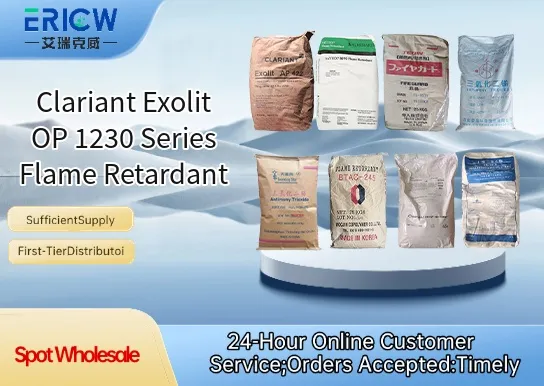
Halogen-free, phosphorus-based flame retardant offering excellent fire safety performance.
Low smoke and low toxicity profile, supporting compliance with stringent fire safety standards.
Good thermal stability enabling processing at typical polymer melt temperatures.
Compatible with polyolefins including PP and PE, facilitating easy compounding and dispersion.
Non-migrating and non-blooming, ensuring long-term flame-retardant efficacy and surface integrity.
Wire and cable jacketing for building infrastructure and data communication cables.
Automotive interior components requiring UL 94 V-0 or V-2 rated materials.
Electrical enclosures and housings in consumer electronics and industrial equipment.
Household appliance parts exposed to potential ignition sources.
Thermoplastic elastomer (TPE) compounds for flexible flame-retardant applications.
| Chemical Type | Organophosphorus compound |
| Product Form | Free-flowing white powder |
| Appearance | White to off-white granular or powdered solid |
| Primary Applications | Polypropylene (PP), polyethylene (PE), and TPE compounds |
| Key Features | Halogen-free, RoHS-compliant, REACH registered |
| Benefits | Enables UL 94 V-0 rating at 1.6 mm thickness in PP; low smoke density |
| Density (approx.) | 1.45–1.55 g/cm³ |
| Decomposition Onset Temperature | ≥280 °C (TGA, 10 K/min, N₂) |
Q1: What is the primary chemical nature of Exolit OP 1230 series?
A: Exolit OP 1230 is an organophosphorus-based flame retardant, specifically formulated as a reactive or additive phosphinate derivative. It functions primarily through condensed-phase action, promoting char formation and reducing combustible volatiles during thermal decomposition.
Q2: In which polymer systems is Exolit OP 1230 most commonly applied?
A: This series is widely used in engineering thermoplastics such as polyamide 6 and polyamide 66, particularly in applications requiring UL 94 V-0 rating at thin wall sections. It also demonstrates good compatibility with polybutylene terephthalate (PBT) and certain polyolefin blends where enhanced flame performance is needed without significant impact on mechanical properties.
Q3: How does Exolit OP 1230 compare to halogenated flame retardants in terms of environmental and processing profile?
A: As a halogen-free solution, Exolit OP 1230 avoids concerns associated with dioxin/furan formation during combustion and complies with global trends toward restricted substances. It offers favorable thermal stability for standard melt-processing conditions and generally exhibits lower volatility and reduced plate-out tendency compared to some alternative phosphorus additives.
Q4: What is the typical dosage range required to achieve flame retardancy in PA6?
A: Dosage depends on formulation requirements, wall thickness, and target flame class—but Exolit OP 1230 is typically effective at low concentrations, generally ranging from 0.1% to 2% by weight in PA6 systems. Optimal loading is determined empirically to balance flame performance, mechanical integrity, and processability.
Contact With Us:
E-mail: wangxingqiang@ericwchem.com
Have a Questions? Call Us:
Add:
Building A1, Jiete Industrial Park, Huangpu District, Guangzhou City, Guangdong Province, China