English
 Español
 tiếng việt
 русский
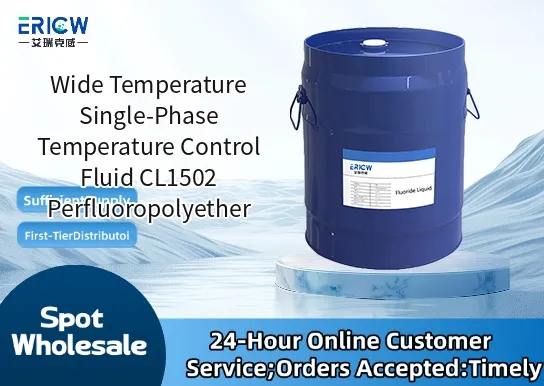
Exceptionally broad operational temperature range: stable single-phase performance from –70 °C to +200 °C.
Chemically inert perfluoropolyether (PFPE) base fluid with outstanding resistance to oxidation, acids, bases, and halogens.
Non-flammable, non-toxic, and zero ozone depletion potential (ODP = 0), compliant with industrial safety standards.
Low vapor pressure and negligible volatility, minimizing fluid loss and system contamination over extended operation.
Excellent thermal stability and long service life under continuous high-temperature cycling without degradation or sludge formation.
High-precision semiconductor manufacturing equipment requiring ultra-stable thermal control during etching and deposition processes.
Avionics and aerospace electro-optical systems operating in extreme ambient conditions (e.g., satellite thermal management).
Laboratory-grade temperature calibration baths and environmental test chambers demanding wide-range, phase-stable heat transfer.
Vacuum-compatible thermal interface fluids for cryogenic to high-temperature vacuum furnaces and analytical instrumentation.
Critical cooling loops in medical imaging devices (e.g., MRI magnet shimming systems) where dielectric integrity and material compatibility are essential.
| Chemical Type | Perfluoropolyether (PFPE), linear K-type structure |
| Product Form | Ambient-stable, clear, colorless liquid |
| Appearance | Transparent, odorless, non-volatile liquid |
| Melting Point | –70 °C (typical, fully amorphous) |
| Boiling Point (at 760 mmHg) | Decomposes >350 °C (no true boiling point; thermally stable up to 200 °C continuous) |
| Primary Applications | Single-phase temperature control, heat transfer, thermal bath media, vacuum-compatible cooling |
| Key Features | Non-reactive, non-corrosive, dielectric (ρ > 10¹⁴ Ω·cm), hydrophobic & oleophobic |
| Regulatory Compliance | REACH registered; RoHS 2015/863 compliant; no SVHCs listed; FDA non-food-contact grade |
| Common Compatible Systems | Suitability |
| Stainless steel (304, 316) and nickel-alloy (Inconel®) circulation loops | Highly Recommended – No corrosion or stress cracking observed under full thermal cycling |
| Viton®, Kalrez®, and Chemraz® elastomer seals | Highly Recommended – Minimal swell (<5%) and retention of mechanical properties at 200 °C |
| Aluminum and titanium heat exchangers | Recommended – Passivated surfaces required; avoid prolonged exposure to unpassivated aluminum |
| Quartz, fused silica, and sapphire optical components | Highly Recommended – Zero leaching, no surface etching or haze formation |
| Standard polyimide and PTFE-insulated wiring harnesses | Suitable – Fully compatible; no insulation swelling or dielectric breakdown |
Q1: What is the CAS Registry Number for CL1502?
A: The CAS Number for CL1502 is 60168-88-9 (generic PFPE K-series reference); exact batch-specific CAS available upon request with CoA.
Q2: How much CL1502 should be used in a closed-loop system, and is pre-flushing required?
A: Fill volume follows standard hydraulic system sizing guidelines (typically 1.2× net loop volume); pre-flushing with isopropyl alcohol or low-viscosity PFPE cleaner is strongly recommended to remove machining oils and particulates prior to fill.
Q3: How does CL1502 compare to standard silicone oils or mineral-based heat transfer fluids?
A: Unlike silicones or hydrocarbons, CL1502 offers superior oxidative stability above 150 °C, zero flammability, no volatile organic compounds (VOCs), and immunity to halogen-based process environments — critical for semiconductor and aerospace applications.
Q4: Does CL1502 meet EU REACH Annex XIV (authorization list) requirements?
A: Yes — CL1502 contains no substances listed in REACH Annex XIV (SVHCs requiring authorization); it is fully compliant for unrestricted industrial use within the EEA.
Q5: Is there risk of migration or extractables into adjacent polymer components or process gases?
A: Migration is negligible due to extremely low vapor pressure (<10⁻⁶ Torr at 25 °C) and molecular weight distribution (>2,000 Da); validated extractables testing per USP <87>/<88> shows no detectable leachables in contact with fluoropolymers or stainless steel under ISO Class 5 cleanroom conditions.
Contact With Us:
E-mail: wangxingqiang@ericwchem.com
Have a Questions? Call Us:
Add:
Building A1, Jiete Industrial Park, Huangpu District, Guangzhou City, Guangdong Province, China