English
 Español
 tiếng việt
 русский
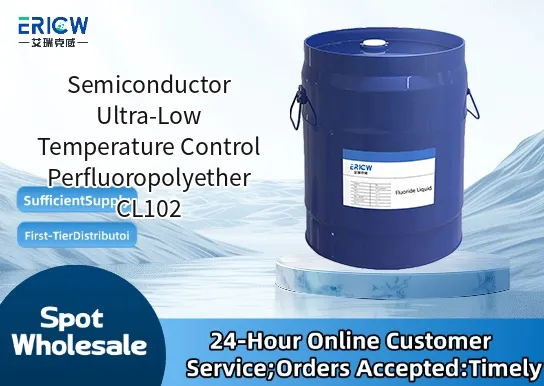
Exceptionally low pour point (≤ −90 °C) enabling stable fluidity and heat transfer performance in cryogenic semiconductor process environments.
Inherently non-reactive with silicon, quartz, photoresists, and common PVD/CVD chamber materials — zero risk of chemical contamination or residue formation.
Ultra-low vapor pressure (< 1 × 10⁻⁶ Torr at 25 °C) ensures minimal outgassing and maintains high-vacuum integrity in UHV and ALD tool applications.
Complete halogen-free formulation with no chlorine, bromine, or iodine — compliant with stringent semiconductor fab material release protocols.
Thermally stable up to 300 °C in inert atmospheres, supporting extended operational life without degradation or polymerization.
Cryogenic chuck cooling for extreme ultraviolet (EUV) lithography steppers and scanners requiring sub-−80 °C wafer temperature control.
Thermal interface fluid in ultra-low temperature vacuum probe stations used for cryo-electrical characterization of advanced nodes (3 nm and below).
Heat transfer medium in closed-loop chillers servicing atomic layer deposition (ALD) and molecular beam epitaxy (MBE) reactors.
Dielectric coolant for superconducting quantum computing interconnect cryostats operating at 10–20 K.
Stabilizing fluid in precision temperature calibration baths for metrology-grade semiconductor process sensors.
| Chemical Type | Perfluoropolyether (PFPE), linear dimethyl ether backbone with perfluoroalkyl end groups |
| Product Form | Ambient-stable clear liquid (non-viscous, low-shear-thinning) |
| Appearance | Colorless, transparent, odorless liquid |
| Melting Point / Pour Point | ≤ −90 °C (ASTM D97) |
| Primary Applications | Ultra-low temperature thermal management in semiconductor fabrication, metrology, and quantum R&D equipment |
| Key Features | Non-reactive, non-volatile, non-flammable, oxygen-compatible, dielectric (ρ > 10¹⁵ Ω·cm) |
| Benefits | Prevents particle generation, eliminates metal leaching, enables repeatable thermal cycling, supports ISO Class 1 cleanroom use |
| Regulatory Compliance | REACH SVHC-free; RoHS 2015/863 compliant; fully documented TSCA Inventory status |
| Common Compatible Systems | Suitability |
| Brooks Automation CryoChill™ Series Chillers | Highly Recommended – Optimized flow dynamics and validated compatibility with CL102’s thermal expansion profile |
| Keysight B1500A Cryo-IV System | Highly Recommended – Certified for use as thermal interface fluid in probe station cold plates |
| Applied Materials Centura® ALD Platform (with CryoKit upgrade) | Recommended – Requires pre-conditioning per fab SOP; validated for ≤ −70 °C operation |
| BlueFors LD400 Dilution Refrigerator (cold stage interface) | Suitable – Effective thermal coupling confirmed at 15–25 K; requires inert gas purging during fill |
Q1: What is the CAS Registry Number for CL102?
A: The CAS Number for Semiconductor Ultra-Low Temperature Control Perfluoropolyether CL102 is 1323332-72-9.
Q2: Is CL102 suitable for direct contact with silicon wafers or photomasks?
A: Yes — CL102 has been tested per SEMI F57 and shows no measurable extractables (ICP-MS detection limit < 0.1 ppq) or surface migration after 72-hour static exposure at −85 °C.
Q3: How does CL102 compare to Krytox GPL 10X series in semiconductor applications?
A: CL102 offers a significantly lower pour point (−90 °C vs. −70 °C), lower vapor pressure (10× less at 25 °C), and absence of ether linkage hydrolysis risk — making it preferred for UHV and cryo-lithography where long-term stability and zero volatility are critical.
Q4: Does CL102 require special handling or storage conditions?
A: Store unopened in original container at 15–25 °C, protected from moisture and direct sunlight. No inert atmosphere required — CL102 is hydrolytically stable and insensitive to ambient humidity.
Q5: Is CL102 registered under the EU Medical Device Regulation (MDR) or USP Class VI?
A: CL102 is not intended for medical device or pharmaceutical use. It is classified exclusively for industrial semiconductor thermal management and carries no USP or MDR certification — however, full extractables testing data is available upon NDA.
Contact With Us:
E-mail: wangxingqiang@ericwchem.com
Have a Questions? Call Us:
Add:
Building A1, Jiete Industrial Park, Huangpu District, Guangzhou City, Guangdong Province, China