English
 Español
 tiếng việt
 русский
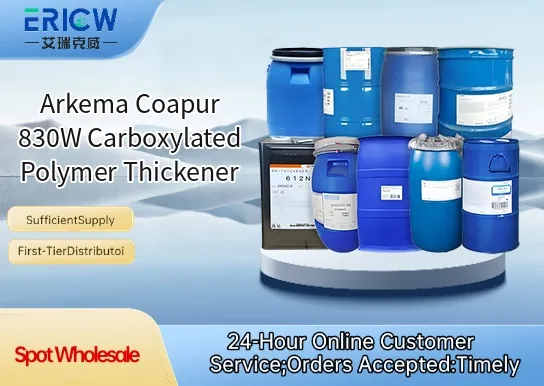
High-shear rheology control with excellent sag resistance in vertical applications.
Non-ionic thickening mechanism ensures compatibility with anionic and cationic systems.
pH-independent viscosity performance across broad pH range (pH 3–12).
Low VOC and APEO-free formulation compliant with global regulatory requirements.
Enhanced film formation and improved scrub resistance in architectural coatings.
Waterborne architectural paints and interior/exterior emulsion paints.
Industrial maintenance coatings including primers and topcoats.
Textile printing pastes requiring stable rheology and pigment suspension.
Adhesives and sealants where non-drip performance is critical.
Tile grouts and cementitious repair mortars for improved workability.
| Chemical Type | Carboxylated acrylic copolymer |
| Product Form | Aqueous dispersion (solids content ~30 wt%) |
| Appearance | Opaque white to off-white liquid |
| pH (10% aqueous solution) | 3.5 – 4.5 |
| Density (20°C) | ~1.02 – 1.05 g/cm³ |
| Viscosity (Brookfield, LVT, Spindle #3, 20 rpm, 25°C) | 500 – 1500 mPa·s |
| Primary Applications | Thickener/rheology modifier for water-based systems |
| Key Features | Non-ionic, high-shear thinning, low foam generation |
Q1: What is the primary function of Coapur 830W in water-based formulations?
A: Coapur 830W is a carboxylated polymer designed to provide efficient rheology modification—particularly high-shear viscosity control and excellent sag resistance—while maintaining good flow and leveling in aqueous systems such as architectural coatings, industrial finishes, and construction mortars.
Q2: How does Coapur 830W differ from non-carboxylated associative thickeners?
A: As a carboxylated polymer, Coapur 830W offers enhanced compatibility with ionic species and improved stability in pH-adjusted systems. Its carboxyl groups enable responsive thickening behavior upon neutralization, allowing formulators greater control over viscosity development and recovery after shear.
Q3: Is Coapur 830W suitable for low-VOC or zero-VOC formulations?
A: Yes—Coapur 830W is supplied as a water-based dispersion with negligible VOC content, making it well-suited for environmentally compliant, low- or zero-VOC coating and adhesive formulations without compromising performance.
Q4: What neutralizing agents are recommended for optimal performance?
A: Common organic and inorganic bases—including AMP-95, TEA, NaOH, and NH₄OH—can be used to neutralize Coapur 830W. Selection depends on desired viscosity profile, pot life, and compatibility with other formulation components; ammonium hydroxide often provides balanced thickening and volatility characteristics.
Q5: Can Coapur 830W be used in combination with other thickeners?
A: Yes—it is frequently blended with cellulosic or other associative thickeners to achieve synergistic rheology profiles, such as improved spatter resistance alongside enhanced leveling, provided compatibility testing is conducted to avoid phase separation or viscosity instability.
Contact With Us:
E-mail: wangxingqiang@ericwchem.com
Have a Questions? Call Us:
Add:
Building A1, Jiete Industrial Park, Huangpu District, Guangzhou City, Guangdong Province, China