English
 Español
 tiếng việt
 русский
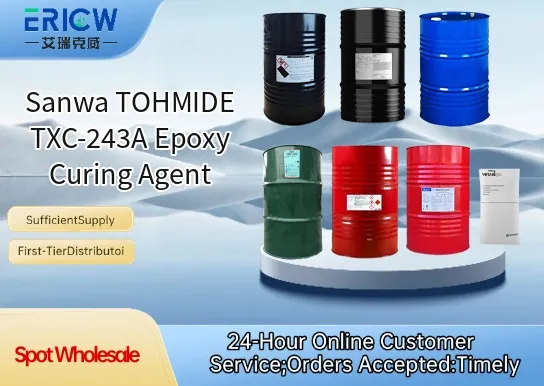
Low-viscosity liquid formulation enabling excellent mixability with standard epoxy resins.
Room-temperature curing capability with rapid gelation and efficient development of mechanical strength.
Superior chemical resistance, particularly to alkalis and solvents, after full cure.
Low exotherm profile during curing—ideal for thick-section or heat-sensitive substrates.
Halogen-free composition supporting compliance with RoHS and green manufacturing requirements.
Electronics encapsulation and potting for PCBs and power modules.
Structural adhesives in automotive assembly and lightweight composite bonding.
High-performance coatings for industrial flooring and corrosion-resistant linings.
Wind turbine blade bonding and repair systems requiring fast turnaround.
Electrical insulation systems in transformers and high-voltage equipment.
| Chemical Type | Modified amine-based curing agent |
| Product Form | Clear to pale yellow liquid |
| Appearance | Homogeneous, low-viscosity liquid at 25°C |
| Primary Applications | Room-temperature and elevated-temperature epoxy curing |
| Key Features | Fast reactivity, low volatility, non-crystallizing |
| Benefits | Improved processing safety, extended pot life vs. conventional amines, reduced blush tendency |
| Storage Stability | 12 months unopened at 5–30°C under dry conditions |
| Compatibility | Compatible with standard DGEBA-type and novolac epoxy resins |
Q1: What is the primary chemical class and functional mechanism of TXC-243A?
A: TXC-243A is an amine-based epoxy curing agent, specifically formulated as a modified aliphatic amine. It functions through nucleophilic addition to epoxide groups, enabling ambient- or low-temperature cure of epoxy resins with reduced volatility and improved handling safety compared to conventional aliphatic amines.
Q2: Is TXC-243A suitable for food-contact or potable water applications?
A: TXC-243A is not pre-qualified for direct food-contact or potable water applications. Its use in such systems requires full formulation-level regulatory evaluation—including extraction testing and compliance verification against applicable regional regulations—by the end-user or compounder.
Q3: How does TXC-243A compare to standard DETA or TETA in terms of pot life and film properties?
A: TXC-243A offers extended pot life relative to unmodified DETA or TETA, especially at ambient temperatures, while still delivering good crosslink density. Cured films typically exhibit enhanced flexibility, lower exotherm, and improved moisture resistance—making it well-suited for thicker-section coatings and adhesives where thermal stress control is critical.
Q4: What epoxy resins is TXC-243A most commonly paired with?
A: TXC-243A demonstrates broad compatibility with standard liquid and solid bisphenol-A and bisphenol-F epoxy resins. It is frequently selected for formulations based on medium-to-high molecular weight resins where balanced reactivity, mechanical performance, and application viscosity are required—such as in industrial maintenance coatings and structural adhesives.
Q5: What is the typical dosage range for TXC-243A in epoxy formulations?
A: Dosage depends on the epoxy equivalent weight (EEW) of the resin and desired cure profile, but TXC-243A is generally used at low concentrations—typically ranging from 0.1% to 2% by weight relative to the total resin solids—enabling efficient stoichiometric control without excessive amine loading.
Contact With Us:
E-mail: wangxingqiang@ericwchem.com
Have a Questions? Call Us:
Add:
Building A1, Jiete Industrial Park, Huangpu District, Guangzhou City, Guangdong Province, China