English
 Español
 tiếng việt
 русский
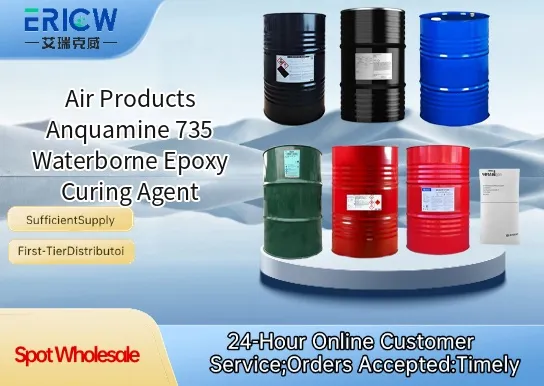
Low-VOC, waterborne amine adduct formulation compliant with global environmental regulations.
Excellent compatibility with standard liquid and solid epoxy resins in aqueous dispersions.
Enables fast ambient-cure film formation with good hardness development within 24–48 hours.
Provides superior adhesion to steel, concrete, and galvanized substrates without primer.
Offers reduced amine blush and improved pot life stability compared to conventional aliphatic amines.
Waterborne epoxy primers and intermediate coats for industrial maintenance coatings.
High-performance floor coatings for commercial and pharmaceutical cleanroom environments.
Anti-corrosive coatings for offshore and marine infrastructure protection.
Concrete sealers and protective topcoats for food processing and beverage facilities.
Hybrid epoxy-acrylic architectural coatings requiring low-odor, low-emission performance.
| Chemical Type | Aliphatic amine adduct (water-dispersible) |
| Product Form | Liquid dispersion |
| Appearance | Off-white to light tan opaque liquid |
| pH (10% aqueous solution) | 9.0–10.5 |
| Solids Content (wt%) | 45–50% |
| Viscosity (Brookfield, #3 spindle, 20 rpm, 25°C) | 1,500–3,000 cP |
| Density (25°C) | 1.02–1.06 g/cm³ |
| Primary Applications | Waterborne epoxy coatings for corrosion protection and decorative finishes |
Q1: What types of epoxy resins is Anquamine 735 compatible with?
A: Anquamine 735 is specifically formulated for use with water-dispersible and water-soluble epoxy resins, including liquid bisphenol-A and bisphenol-F based epoxy dispersions. It is not recommended for solvent-based or 100% solids epoxy systems without prior compatibility testing.
Q2: How does Anquamine 735 contribute to low-VOC performance in finished coatings?
A: As a waterborne curing agent, Anquamine 735 enables formulators to develop high-performance epoxy coatings with significantly reduced volatile organic compound content—typically well below regulatory thresholds for architectural and industrial maintenance applications—without requiring co-solvents for stabilization.
Q3: What are the typical cure conditions required for optimal film formation?
A: Anquamine 735 provides ambient-cure capability, with practical handling strength developing within hours at 23°C and 50% relative humidity. Full chemical resistance and mechanical properties are generally achieved after 5–7 days under ambient conditions, though elevated temperatures (e.g., 40–60°C) can accelerate crosslinking for production-line efficiency.
Q4: Can Anquamine 735 be used in food-contact or potable water applications?
A: Anquamine 735 is not pre-qualified for direct food-contact or potable water applications. Its suitability for such uses depends on full formulation evaluation—including final cured-film extraction testing—and compliance with applicable regional regulatory frameworks, which must be confirmed by the end-user or certified third-party laboratory.
Contact With Us:
E-mail: wangxingqiang@ericwchem.com
Have a Questions? Call Us:
Add:
Building A1, Jiete Industrial Park, Huangpu District, Guangzhou City, Guangdong Province, China