English
 Español
 tiếng việt
 русский
High reactivity with epoxy resins, enabling rapid cure at ambient or slightly elevated temperatures.
Excellent chemical resistance post-cure, particularly against solvents, acids, and alkalis.
Low viscosity for easy handling and homogeneous mixing with standard epoxy systems.
Good thermal stability and glass transition temperature (Tg) development in cured networks.
Compatible with a broad range of bisphenol-A and bisphenol-F based epoxy resins.
Structural adhesives for automotive and aerospace bonding applications.
Electrical encapsulation and potting compounds for power electronics and transformers.
High-performance coatings for industrial flooring and chemical containment linings.
Composite matrix resins for wind turbine blade manufacturing and pultrusion.
Repair mortars and grouts requiring fast turnaround and high mechanical strength.
| Chemical Type | Amine-based aliphatic curing agent |
| Product Form | Liquid |
| Appearance | Pale yellow to amber clear liquid |
| Primary Applications | Epoxy resin curing for adhesives, coatings, composites, and electrical encapsulation |
| Key Features | Fast ambient cure, low viscosity, high crosslink density |
| Benefits | Reduced processing time, excellent adhesion, superior chemical resistance |
| Storage Stability | At least 12 months at 20–25 °C in original sealed container |
| Compatibility | Standard DGEBA and DGEBF epoxy resins |
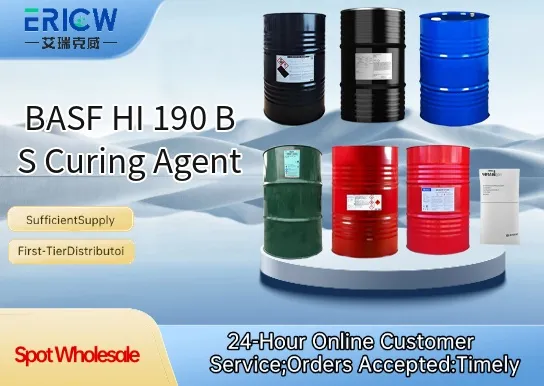
Q1: What is the primary function of BASF HI 190 B S in epoxy systems?
A: BASF HI 190 B S is a latent, low-odor curing agent designed to enable controlled reactivity in epoxy resins—providing extended pot life at ambient temperature and rapid, uniform crosslinking upon thermal activation.
Q2: Is HI 190 B S suitable for applications requiring low volatility and minimal odor during processing?
A: Yes—HI 190 B S is formulated as a solid, non-volatile compound with very low vapor pressure and negligible odor, making it well-suited for indoor applications, confined spaces, and environments where worker exposure and air quality are key considerations.
Q3: How does HI 190 B S compare to traditional dicyandiamide (DICY) in terms of handling and dispersion?
A: Unlike DICY, HI 190 B S exhibits improved wettability and dispersibility in common epoxy resins, reducing the risk of agglomeration and enabling more homogeneous formulations without high-shear mixing or extended milling.
Q4: What is the typical thermal activation profile for full cure with HI 190 B S?
A: Full crosslinking generally occurs within a moderate temperature range of 130–160 °C, with cure times varying based on part geometry and thermal mass—typically from 20 minutes to 2 hours. Lower temperatures may be used with extended dwell times, while higher temperatures accelerate the process.
Q5: Can HI 190 B S be used in combination with accelerators to fine-tune cure kinetics?
A: Yes—HI 190 B S is compatible with common epoxy accelerators such as substituted ureas or imidazoles, allowing formulators to adjust latency and cure speed without compromising final network performance or shelf stability.
Contact With Us:
E-mail: wangxingqiang@ericwchem.com
Have a Questions? Call Us:
Add:
Building A1, Jiete Industrial Park, Huangpu District, Guangzhou City, Guangdong Province, China