English
 Español
 tiếng việt
 русский
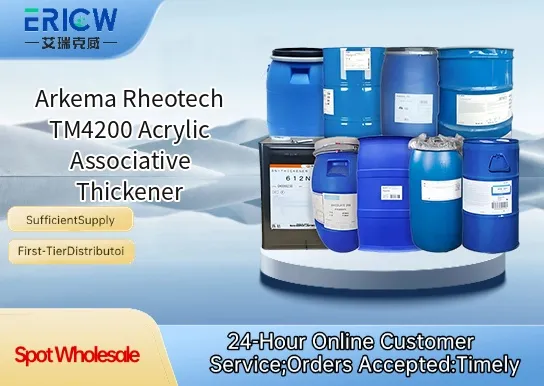
Delivers excellent rheology control with high mid-shear viscosity and outstanding sag resistance.
Provides superior compatibility with anionic and nonionic surfactants in waterborne systems.
Offers robust freeze-thaw stability and long-term storage stability in architectural and industrial coatings.
Enables low foaming performance and easy incorporation without pre-dilution or high-shear mixing.
Delivers balanced flow and leveling while maintaining excellent spatter resistance during application.
Architectural interior and exterior flat and low-sheen latex paints.
Industrial maintenance coatings for metal and concrete substrates.
Waterborne wood finishes and stains requiring controlled viscosity and brushability.
Textile printing pastes and functional coating formulations.
Adhesives and sealants where associative thickening and shear-thinning behavior are critical.
| Chemical Type | Acrylic-based associative thickener |
| Product Form | Liquid dispersion |
| Appearance | Opaque white to off-white viscous liquid |
| pH (1% aqueous solution) | 6.5 – 7.5 |
| Active Content (wt%) | 30.0 ± 1.0% |
| Viscosity (Brookfield RVT, spindle #3, 20 rpm, 25°C) | 8,000 – 15,000 cP |
| Primary Applications | Waterborne coatings, adhesives, and functional dispersions |
| Key Features | Non-ionic associative mechanism, low VOC, APEO-free |
Q1: What type of rheology does Rheotech TM4200 provide in waterborne formulations?
A: Rheotech TM4200 is an acrylic associative thickener designed to deliver strong pseudoplastic (shear-thinning) behavior with excellent high-shear flow and good low-shear viscosity build—ideal for improving sag resistance while maintaining brushability and sprayability in architectural coatings and industrial finishes.
Q2: Is Rheotech TM4200 compatible with common surfactants and co-thickeners used in latex paints?
A: Yes, TM4200 exhibits broad compatibility with nonionic and anionic surfactants, as well as with cellulosic thickeners and other associative thickeners. However, optimal performance requires careful sequencing during let-down and evaluation of interactions in the full formulation matrix.
Q3: How should Rheotech TM4200 be incorporated into a formulation to ensure consistent performance?
A: It is recommended to pre-dilute TM4200 with water or a compatible solvent before addition, followed by gradual incorporation under moderate agitation during the let-down stage. Avoid direct addition to highly ionic or low-pH environments without prior dilution to prevent premature association or viscosity spikes.
Q4: Does Rheotech TM4200 offer any advantages over traditional hydrophobically modified ethoxylated urethanes (HEURs)?
A: As an acrylic-based associative thickener, TM4200 provides enhanced alkali resistance and improved compatibility with high-ionic-strength systems compared to many HEUR thickeners, along with more predictable viscosity development in ambient-cure applications.
Contact With Us:
E-mail: wangxingqiang@ericwchem.com
Have a Questions? Call Us:
Add:
Building A1, Jiete Industrial Park, Huangpu District, Guangzhou City, Guangdong Province, China