English
 Español
 tiếng việt
 русский
Excellent adhesion to glass and various substrates, ensuring strong interlayer bonding in laminated safety glass.
Superior optical clarity and long-term UV stability, minimizing yellowing and maintaining light transmission.
Optimized melt flow and processing rheology for consistent extrusion and calendering performance.
High tensile strength and impact resistance, meeting stringent automotive and architectural safety standards.
Low volatile organic compound (VOC) content, supporting eco-friendly manufacturing and indoor air quality compliance.
Automotive laminated windshields and side windows.
Architectural safety glazing for facades, skylights, and overhead installations.
Security and blast-resistant glass systems.
Photovoltaic module encapsulation layers.
Acoustic laminated glass for noise reduction in transportation and buildings.
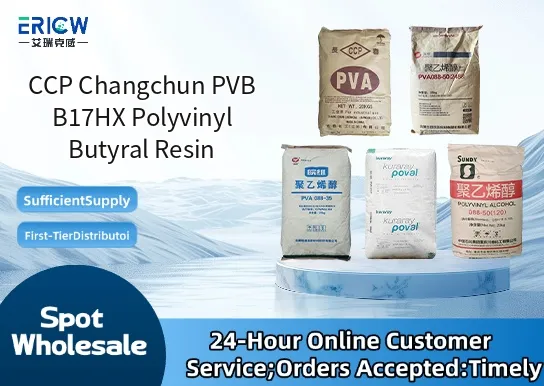
| Chemical Type | Polyvinyl butyral (PVB) resin |
| Product Form | Free-flowing white to off-white granules |
| Appearance | Uniform granular solid, free of visible impurities |
| Primary Applications | Laminated safety glass interlayer |
| Key Features | High adhesion, optical clarity, UV resistance, processability |
| Benefits | Enhanced safety performance, durability, and manufacturability |
| Storage Conditions | Store in cool, dry, well-ventilated area; avoid direct sunlight and moisture |
| Standard Packaging | 25 kg multi-layer paper/polyethylene bags or 500 kg palletized big bags |
Q1: What is the primary functional role of CCP Changchun PVB B17HX in adhesive and coating formulations?
A: CCP Changchun PVB B17HX serves primarily as a film-forming binder and adhesion promoter, enhancing interfacial bonding between dissimilar substrates—especially in laminated safety glass interlayers and specialty protective coatings. Its balanced hydroxyl and butyral group content supports strong cohesive strength and compatibility with both polar and moderately non-polar resins.
Q2: How does B17HX differ from standard PVB resins in terms of solubility and processing behavior?
A: B17HX is engineered for improved solubility in common industrial solvent blends—including alcohol/toluene and alcohol/ester mixtures—enabling faster dissolution and more uniform solution viscosity at ambient temperatures. It also exhibits reduced gel formation tendency during storage and handling compared to higher-molecular-weight or highly crosslinkable PVB grades.
Q3: Is B17HX suitable for use in food-contact or medical-grade laminates?
A: While B17HX meets general industrial purity requirements for laminated glass and protective films, it is not pre-qualified for direct food-contact or implantable medical applications. Customers intending such use must conduct full regulatory evaluation—including extractables testing and formulation-specific biocompatibility assessment—as suitability depends on final product configuration, processing conditions, and end-use compliance requirements.
Q4: What are the recommended storage conditions to maintain long-term stability of B17HX resin?
A: Store B17HX in its original sealed packaging under cool, dry conditions—ideally below 30 °C and with relative humidity below 60%. Avoid prolonged exposure to moisture, direct sunlight, or temperature fluctuations, as these may affect powder flow characteristics and solution clarity over time.
Contact With Us:
E-mail: wangxingqiang@ericwchem.com
Have a Questions? Call Us:
Add:
Building A1, Jiete Industrial Park, Huangpu District, Guangzhou City, Guangdong Province, China