English
 Español
 tiếng việt
 русский
High adhesion strength to glass and polycarbonate substrates for reliable interlayer bonding.
Excellent optical clarity and low haze, meeting stringent requirements for automotive and architectural safety glazing.
Superior UV resistance and long-term weatherability, minimizing yellowing and delamination under prolonged exposure.
Consistent melt flow behavior enabling stable extrusion and lamination process control.
Low residual acetaldehyde content, supporting compliance with indoor air quality and food-contact-adjacent applications.
Automotive laminated safety glass (windshields, sunroofs, side windows).
Architectural laminated glass for façades, skylights, and blast-resistant installations.
Photovoltaic module encapsulation layers for enhanced durability and moisture barrier performance.
Security and anti-shatter films for retrofit glazing solutions.
Acoustic interlayers in noise-reducing laminated glass systems.
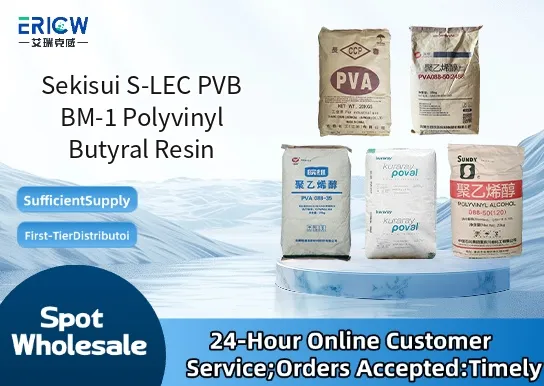
| Chemical Type | Polyvinyl butyral (PVB) resin |
| Product Form | Free-flowing white granules |
| Appearance | Off-white to light yellow granules, uniform particle size |
| Primary Applications | Laminated safety glass interlayer |
| Key Features | High transparency, excellent adhesion, thermal stability, UV stability |
| Benefits | Enhanced safety performance, process reliability, long service life |
| Standard Packaging | 20 kg multi-layer paper/polyethylene bags |
| Storage Conditions | Store in cool, dry, well-ventilated area; avoid direct sunlight and moisture |
Q1: What is the primary functional role of S-LEC PVB BM-1 in adhesive and coating formulations?
A: S-LEC PVB BM-1 functions primarily as a film-forming binder and adhesion promoter, enhancing cohesion, flexibility, and interfacial bonding—especially between polar substrates such as glass, metals, and treated plastics.
Q2: How does BM-1 differ from standard PVB resins used in laminated safety glass?
A: Unlike high-molecular-weight PVB grades optimized for structural interlayers in architectural or automotive laminated glass, BM-1 is specially modified for solution-based industrial applications—offering improved solubility in common organic solvents and tailored rheology for coatings, inks, and specialty adhesives.
Q3: Which solvents are typically compatible with S-LEC PVB BM-1 for formulation purposes?
A: BM-1 demonstrates good solubility in alcohols (e.g., ethanol, isopropanol), ketones (e.g., methyl ethyl ketone, acetone), and esters (e.g., ethyl acetate), and is commonly used in mixed-solvent systems to balance evaporation rate and film formation.
Q4: Is S-LEC PVB BM-1 suitable for food-contact or pharmaceutical-related applications?
A: While PVB resins are widely used in certain indirect food-contact applications (e.g., overprint varnishes on packaging), BM-1 is not pre-qualified for direct food-contact or pharmaceutical use; customers must conduct full regulatory evaluation and testing specific to their end-use and jurisdiction.
Q5: What handling precautions should be observed during processing?
A: As with most organic polymer powders, appropriate dust control measures (e.g., local exhaust ventilation) and personal protective equipment (e.g., respirator for powder handling, gloves for solvent contact) are recommended. Avoid prolonged inhalation of airborne particles and ensure adequate ventilation when dissolving in volatile solvents.
Contact With Us:
E-mail: wangxingqiang@ericwchem.com
Have a Questions? Call Us:
Add:
Building A1, Jiete Industrial Park, Huangpu District, Guangzhou City, Guangdong Province, China