English
 Español
 tiếng việt
 русский
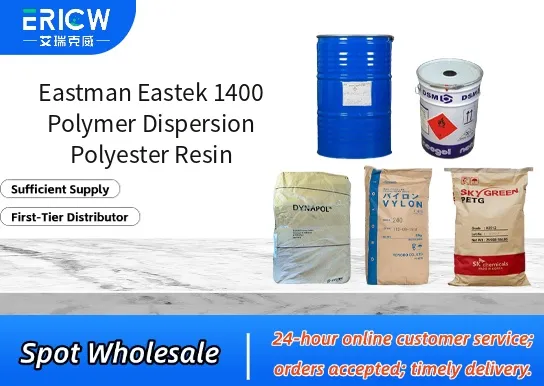
Waterborne polyester dispersion offering excellent film formation and clarity.
Low VOC formulation compliant with stringent environmental and regulatory requirements.
Good hydrolytic stability for extended storage and processing reliability.
Compatible with common co-binders and crosslinkers used in industrial coatings.
Enables high-gloss, durable finishes with balanced hardness and flexibility.
Industrial maintenance coatings for metal substrates.
Waterborne coil coatings requiring corrosion resistance and adhesion.
General-purpose protective topcoats for architectural and OEM applications.
Refinish coatings where low-odor, fast-drying performance is essential.
Hybrid systems combining acrylic and polyester functionality in eco-friendly formulations.
| Chemical Type | Polyester dispersion (waterborne) |
| Product Form | Liquid dispersion |
| Appearance | Opaque white to off-white liquid |
| pH (at 25°C) | 7.5–8.5 |
| Solids Content (wt%) | 40–42% |
| Viscosity (mPa·s, Brookfield RVT, spindle #3, 20 rpm) | 150–350 |
| Density (g/cm³, at 25°C) | 1.02–1.06 |
| Minimum Film Formation Temperature (MFFT) | ≈ 25°C |
Q1: What is the primary function of Eastman Eastek 1400 in coating formulations?
A: Eastek 1400 functions as a film-forming polymer dispersion that enhances adhesion, flexibility, and chemical resistance in waterborne industrial coatings—particularly where improved substrate wetting and low-temperature film coalescence are required.
Q2: Is Eastek 1400 compatible with common waterborne acrylic or vinyl acetate-based dispersions?
A: Yes, Eastek 1400 is designed for broad compatibility with many waterborne polymer systems, including acrylics and VAE dispersions. Compatibility should be confirmed through small-scale formulation trials to assess stability, viscosity behavior, and final film properties.
Q3: How does Eastek 1400 contribute to performance in can and coil coatings?
A: In can and coil coating applications, Eastek 1400 supports excellent metal adhesion, corrosion inhibition synergy with pigments and inhibitors, and good resistance to sterilization and cleaning agents—making it suitable for demanding food-contact and industrial metal packaging environments.
Q4: What are the recommended storage conditions for Eastek 1400?
A: Store in original, tightly sealed containers at temperatures between 5 °C and 30 °C. Avoid freezing and prolonged exposure to temperatures above 35 °C. Protect from direct sunlight and ensure adequate ventilation in storage areas.
Contact With Us:
E-mail: wangxingqiang@ericwchem.com
Have a Questions? Call Us:
Add:
Building A1, Jiete Industrial Park, Huangpu District, Guangzhou City, Guangdong Province, China