English
 Español
 tiếng việt
 русский
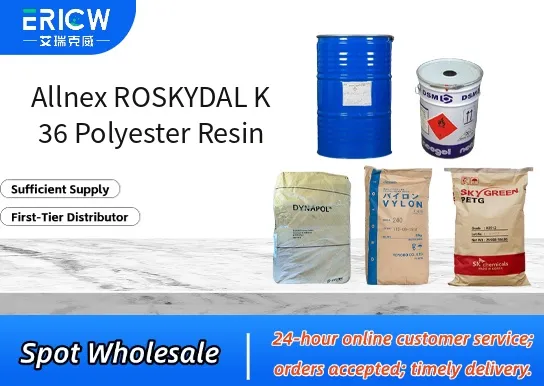
High-solids, low-viscosity unsaturated polyester resin for efficient processing and reduced VOC emissions.
Excellent mechanical strength and impact resistance after curing with styrene and peroxide initiators.
Good compatibility with common fillers, pigments, and glass fiber reinforcements.
Consistent batch-to-batch performance supported by stringent Allnex quality control protocols.
Optimized for ambient and elevated temperature cure systems in open-mold and centrifugal casting processes.
Fiberglass-reinforced plastic (FRP) tanks and vessels for chemical storage.
Corrosion-resistant ducting and scrubber components in industrial air pollution control systems.
Structural panels and cladding for architectural and infrastructure projects.
Marine deck cores and hull laminates requiring dimensional stability and moisture resistance.
Electrical insulators and enclosures in medium-voltage power distribution equipment.
| Chemical Type | Unsaturated polyester resin |
| Product Form | Liquid |
| Appearance | Clear to pale yellow viscous liquid |
| Solids Content (wt%) | ~99.5% |
| Viscosity (mPa·s, 25°C) | 250–450 |
| Density (g/cm³, 25°C) | 1.10–1.14 |
| Styrene Content (wt%) | 38–42 |
| Reactivity Class | Medium-reactive (standard MEKP-initiated cure) |
Q1: What is the primary function of ROSKYDAL K 36 in coating formulations?
A: ROSKYDAL K 36 is a low-viscosity, high-solids unsaturated polyester resin designed primarily as a reactive diluent and viscosity modifier in UV-curable and radiation-curable coatings. It contributes to improved film formation, enhanced crosslink density, and reduced shrinkage during cure.
Q2: Is ROSKYDAL K 36 compatible with common photoinitiator systems?
A: Yes, ROSKYDAL K 36 exhibits good compatibility with standard Type I (cleavage) and Type II (hydrogen-abstraction) photoinitiators used in UV-curable systems, including benzophenone derivatives and alpha-hydroxy ketones. Compatibility should always be verified in the final formulation due to potential interactions with other components.
Q3: How does ROSKYDAL K 36 influence cure speed and final film properties?
A: Due to its high reactivity and low viscosity, ROSKYDAL K 36 generally supports faster surface cure and deeper through-cure in UV systems. It enhances hardness, chemical resistance, and gloss retention in the cured film, while maintaining flexibility depending on overall formulation balance.
Q4: Can ROSKYDAL K 36 be used in solvent-borne or high-solids thermally cured systems?
A: While optimized for UV and EB curing, ROSKYDAL K 36 may be incorporated into high-solids thermally cured polyester-acrylic hybrid systems where low volatility and controlled reactivity are beneficial. However, thermal cure performance requires careful optimization of catalysts and bake profiles, and full compatibility must be confirmed experimentally.
Contact With Us:
E-mail: wangxingqiang@ericwchem.com
Have a Questions? Call Us:
Add:
Building A1, Jiete Industrial Park, Huangpu District, Guangzhou City, Guangdong Province, China