English
 Español
 tiếng việt
 русский
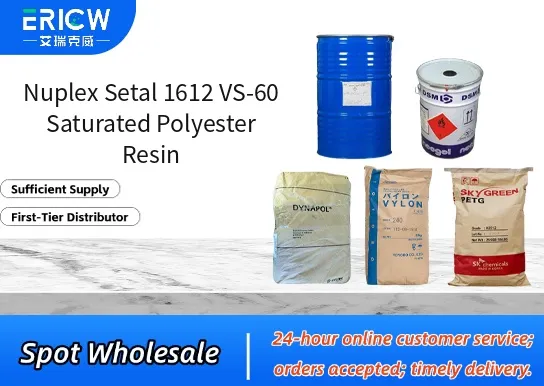
Low-viscosity liquid form enabling excellent flow and leveling in coating formulations.
High solids content for reduced VOC emissions and improved film build efficiency.
Excellent compatibility with common crosslinkers including melamine formaldehyde resins.
Superior hardness and chemical resistance after cure, suitable for demanding industrial finishes.
Consistent batch-to-batch performance ensured by stringent quality control during manufacturing.
Automotive OEM and refinish topcoats requiring high gloss and durability.
Industrial metal coatings for appliances, furniture, and architectural panels.
Coil coating systems where rapid cure response and excellent edge coverage are critical.
General-purpose baking enamels for metal substrates requiring flexibility and adhesion.
High-performance powder coating base resins when blended with appropriate curing agents.
| Chemical Type | Saturated polyester resin |
| Product Form | Clear to pale yellow viscous liquid |
| Appearance | Homogeneous, free from sediment or haze |
| Primary Applications | Baking enamel coatings, coil coatings, industrial finishes |
| Key Features | Low viscosity, high solids, melamine-reactive |
| Benefits | Reduced VOC, fast cure response, excellent film integrity |
| Storage Stability | Stable under dry, cool conditions (≤25°C) for ≥12 months |
| Recommended Cure Schedule | 180–200°C for 10–20 minutes (with melamine crosslinker) |
Q1: What is the primary application of Setal 1612 VS-60 in coating systems?
A: Setal 1612 VS-60 is a low-viscosity, high-solids saturated polyester resin designed primarily as a binder in high-performance coil and can coatings, especially where excellent gloss retention, hardness development, and resistance to humidity and chemicals are required.
Q2: Is Setal 1612 VS-60 compatible with common crosslinkers used in industrial baking finishes?
A: Yes — it is formulated for compatibility with standard amino resins such as melamine-formaldehyde and urea-formaldehyde crosslinkers, enabling robust cure profiles under typical metal coil coating bake conditions (e.g., 200–250 °C for short dwell times).
Q3: How does Setal 1612 VS-60 contribute to film flexibility and adhesion on metal substrates?
A: Its molecular design balances rigidity and chain mobility, supporting strong interfacial adhesion to pretreated steel and aluminum while maintaining good bend and impact resistance — critical for formable coil-coated products.
Q4: Can Setal 1612 VS-60 be used in low-VOC or high-solids formulations?
A: Yes — its inherently low viscosity and high solids content support formulation strategies aimed at reducing solvent usage without compromising flow, leveling, or film integrity in industrial baking applications.
Contact With Us:
E-mail: wangxingqiang@ericwchem.com
Have a Questions? Call Us:
Add:
Building A1, Jiete Industrial Park, Huangpu District, Guangzhou City, Guangdong Province, China