English
 Español
 tiếng việt
 русский
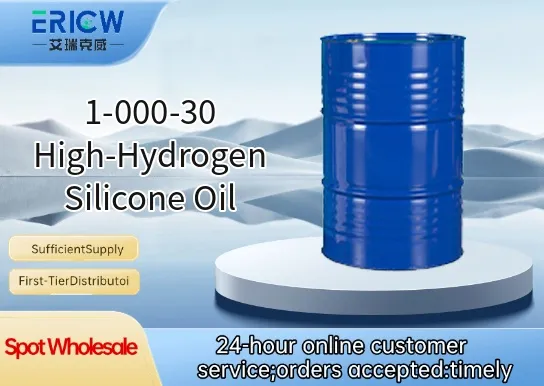
High active hydrogen content enables efficient hydrosilylation reactions with alkenes and alkynes.
Low viscosity (30 cSt at 25°C) ensures excellent processability and uniform dispersion in formulations.
Thermally stable up to 200°C, supporting high-temperature curing processes without premature decomposition.
Consistent Si–H functionality distribution ensures reproducible crosslinking kinetics and final product performance.
Low volatility and minimal cyclic siloxane content meet stringent VOC and regulatory requirements for industrial use.
Hydrosilylation-based silicone rubber curing agents for high-performance elastomers.
Crosslinker in heat-curable liquid silicone rubber (LSR) for medical and automotive components.
Surface modification agent for silica fillers and nanomaterials to enhance hydrophobicity and dispersion.
Key intermediate in the synthesis of silicone surfactants and functional silicone resins.
Adhesion promoter in silicone pressure-sensitive adhesives (PSAs) and release coatings.
| Chemical Type | Methylhydrogen polysiloxane (linear) |
| Product Form | Clear, colorless liquid |
| Appearance | Transparent, mobile liquid, free from visible particulates |
| Viscosity (25°C) | 28–32 cSt |
| Hydrogen Content (Si–H) | 0.95–1.05 wt% |
| Density (25°C) | 0.97–0.99 g/cm³ |
| Refractive Index (25°C) | 1.400–1.405 |
| Flash Point (COC) | ≥180°C |
Q1: What is the primary functional role of 1-000-30 High-Hydrogen Silicone Oil in formulations?
A: It serves primarily as a reactive silicone modifier—its high hydrogen content enables covalent bonding with unsaturated or hydroxyl-bearing substrates via hydrosilylation or condensation reactions, enhancing surface durability, release performance, and interfacial compatibility.
Q2: Is 1-000-30 suitable for use in heat-cured silicone rubber systems?
A: Yes—it is commonly incorporated into high-temperature vulcanizing (HTV) and liquid silicone rubber (LSR) formulations to improve filler dispersion, reduce compound viscosity during processing, and contribute to crosslink density when paired with platinum catalysts.
Q3: How does 1-000-30 differ from standard dimethyl silicone oils in terms of compatibility and reactivity?
A: Unlike non-reactive dimethyl silicone oils, 1-000-30 contains multiple Si–H groups per molecule, making it chemically active rather than inert. This allows it to participate in network formation, offering superior anchoring in coatings, adhesives, and reinforced elastomers where permanent integration—not just migration or blooming—is required.
Q4: What are typical handling and storage recommendations for this product?
A: Store in tightly sealed containers under dry, cool conditions away from moisture, strong oxidizers, and direct sunlight. Due to its reactive Si–H functionality, prolonged exposure to ambient humidity or catalytic residues may lead to gradual viscosity increase or gelation over time.
Q5: Can 1-000-30 be used in food-contact or pharmaceutical applications?
A: While it meets general industrial-grade purity specifications, 1-000-30 is not pre-certified for direct food-contact or pharmaceutical use. Customers intending such applications must conduct full regulatory evaluation—including compatibility testing and compliance verification—based on their specific formulation and jurisdictional requirements.
Contact With Us:
E-mail: wangxingqiang@ericwchem.com
Have a Questions? Call Us:
Add:
Building A1, Jiete Industrial Park, Huangpu District, Guangzhou City, Guangdong Province, China