English
 Español
 tiếng việt
 русский
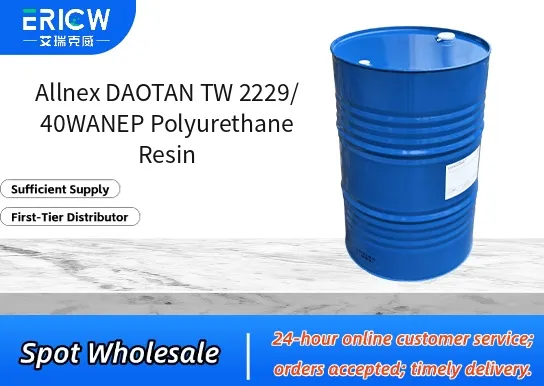
High-solids, solvent-borne aliphatic polyurethane dispersion offering excellent weather resistance and UV stability.
Designed for outstanding film formation at ambient temperature with low VOC content.
Provides superior scratch resistance, chemical resistance, and mechanical toughness in cured films.
Excellent compatibility with acrylics, melamines, and other common coating resins for hybrid formulations.
Good hydrolytic stability and storage shelf life under recommended conditions.
High-performance industrial maintenance coatings for metal substrates.
Architectural façade and cladding coatings requiring long-term gloss retention.
Coatings for transportation interiors (e.g., buses, railcars, aircraft cabins).
Premium wood finishes demanding clarity, hardness, and yellowing resistance.
Plastic substrate coatings where flexibility and adhesion balance are critical.
| Chemical Type | Aliphatic polyurethane dispersion |
| Product Form | Liquid, solvent-borne |
| Appearance | Clear to slightly hazy amber liquid |
| Primary Applications | Industrial maintenance, architectural, transportation, wood, and plastic coatings |
| Key Features | UV-stable, high-solids, ambient-curing, low-VOC, hydrolytically stable |
| Benefits | Enhanced durability, reduced formulation complexity, improved regulatory compliance |
| Recommended Diluent | Aromatic-free mineral spirits or approved ester/ketone blends |
| Storage Stability | ≥12 months at 5–30 °C in unopened original container |
Q1: What is the primary function of DAOTAN TW 2229/40WANEP in polyurethane systems?
A: DAOTAN TW 2229/40WANEP is a waterborne polyurethane dispersion designed to serve as a film-forming binder or reactive modifier, enhancing flexibility, adhesion, and mechanical durability in final coatings and adhesives.
Q2: Is this resin compatible with common crosslinkers used in industrial PU formulations?
A: Yes — it is formulated for compatibility with standard aqueous crosslinkers such as aziridine, carbodiimide, and blocked isocyanate types. Compatibility and reactivity should be verified experimentally under specific formulation conditions.
Q3: How does DAOTAN TW 2229/40WANEP perform in terms of drying behavior and film formation?
A: It exhibits good coalescence and film formation at ambient and moderate elevated temperatures, forming continuous, flexible films without requiring high-temperature curing. Drying kinetics depend on substrate, humidity, air flow, and film thickness.
Q4: Can this resin be blended with acrylic dispersions or other waterborne polymers?
A: Yes — it is generally miscible with many anionic and non-ionic acrylic dispersions, though stability and phase compatibility must be assessed case by case through compatibility testing and storage evaluation.
Q5: What are typical application methods for coatings based on this resin?
A: It is suitable for conventional waterborne application techniques including spray coating, dip coating, roller coating, and curtain coating — with formulation adjustments (e.g., rheology modifiers, defoamers) often required to optimize performance for each method.
Contact With Us:
E-mail: wangxingqiang@ericwchem.com
Have a Questions? Call Us:
Add:
Building A1, Jiete Industrial Park, Huangpu District, Guangzhou City, Guangdong Province, China