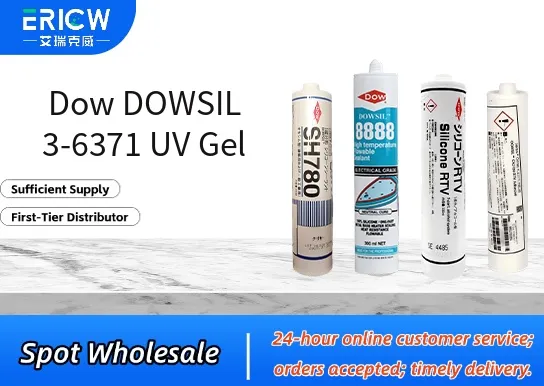
Ultra-low modulus silicone gel formulation for exceptional stress relief and thermal cycling performance.
Fast, one-step UV curing at room temperature—no heat or moisture required.
Excellent adhesion to diverse substrates including plastics, glass, ceramics, and coated metals.
Outstanding long-term stability with minimal outgassing and low ionic impurities.
Optically clear, non-yellowing formulation suitable for sensitive optical and LED applications.
Encapsulation and protection of surface-mount LEDs (SMD LEDs) and micro-LED arrays.
Underfill and stress-relief bonding for miniaturized sensors and MEMS devices.
Optical coupling and lens overmolding in automotive lighting and head-up display (HUD) modules.
Conformal coating and edge sealing for flexible printed circuit boards (FPCBs) in wearables.
Die attach and cavity filling for high-reliability optoelectronic assemblies.
| Chemical Type | UV-curable aliphatic silicone gel |
| Product Form | Thixotropic viscous liquid (paste-like) |
| Appearance | Clear, colorless to pale yellow gel |
| Primary Applications | Optoelectronic encapsulation, LED protection, MEMS stress relief |
| Key Features | Low modulus (~0.1–0.3 MPa), rapid UV cure (< 30 s @ 365 nm), no byproducts |
| Benefits | Superior thermal shock resistance, minimal CTE mismatch, halogen-free |
| Shelf Life | 6 months unopened at 5–25 °C, protected from UV light |
| Compliance | RoHS 2015/863/EU, REACH SVHC free, UL 94 V-0 (cured) |
Q1: What is the primary function of DOWSIL 3-6371 UV Gel in formulations?
A: DOWSIL 3-6371 UV Gel is a silicone-based rheology modifier designed to provide controlled viscosity, excellent suspension stability, and improved sag resistance in UV-curable systems—particularly in coatings, inks, and adhesives where uniform film formation and particle dispersion are critical.
Q2: Is DOWSIL 3-6371 UV Gel compatible with common UV-curable resins such as acrylates and epoxy acrylates?
A: Yes, it demonstrates broad compatibility with standard UV-curable monomers and oligomers, including multifunctional acrylates and epoxy acrylates. It typically disperses readily under moderate shear and remains stable throughout UV curing without interfering with photoinitiator activity or final crosslink density.
Q3: How should DOWSIL 3-6371 UV Gel be incorporated into a UV formulation?
A: It is generally added during the pigment or filler dispersion stage under moderate agitation. Pre-dispersing in a portion of the resin or monomer prior to full formulation integration helps ensure uniform distribution and optimal rheological performance.
Q4: Does DOWSIL 3-6371 UV Gel affect the UV cure speed or final film properties?
A: When used at recommended levels, it does not significantly inhibit UV cure kinetics or compromise key film properties such as hardness, flexibility, or adhesion. Its inert silicone backbone contributes minimal interference to photopolymerization, supporting consistent through-cure in typical coating thicknesses.
Q5: What storage conditions are recommended for DOWSIL 3-6371 UV Gel?
A: Store in original sealed containers at temperatures between 5 °C and 30 °C, away from direct sunlight and moisture. Avoid freezing, and ensure containers remain tightly closed when not in use to maintain consistency and performance over time.
Contact With Us:
E-mail: wangxingqiang@ericwchem.com
Have a Questions? Call Us:
Add:
Building A1, Jiete Industrial Park, Huangpu District, Guangzhou City, Guangdong Province, China
 English
 Español
 tiếng việt
 русский