English
 Español
 tiếng việt
 русский
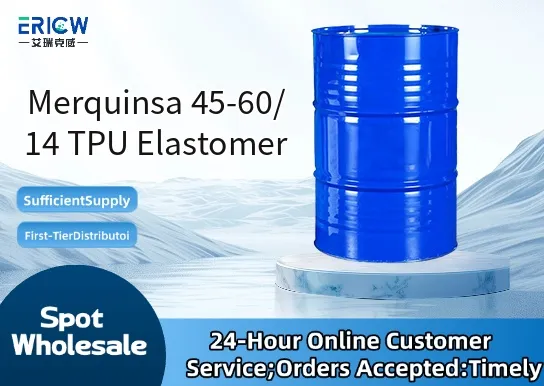
Excellent abrasion resistance for demanding mechanical environments.
High elasticity and recovery performance across a wide temperature range.
Good processability via extrusion, injection molding, and calendering.
Outstanding oil and grease resistance compared to conventional thermoplastic elastomers.
Hydrolysis-stabilized formulation suitable for humid or wet-condition applications.
Industrial hoses and pneumatic tubing requiring flexibility and durability.
Automotive interior trim components including seals, gaskets, and soft-touch overlays.
Conveyor belts and wear-resistant linings in material handling systems.
Footwear midsoles and outsoles demanding resilience and comfort.
Cable jacketing and protective sheathing for flexible electrical and data cables.
| Chemical Type | Aliphatic polyester-based thermoplastic polyurethane (TPU) |
| Product Form | Pellets |
| Appearance | Off-white to light beige granules |
| Hardness (Shore A) | 45–60 |
| Melt Flow Index (210 °C / 5 kg) | 12–16 g/10 min |
| Density | 1.18–1.21 g/cm³ |
| Primary Applications | Extruded profiles, molded parts, coated fabrics |
| Key Features | Abrasion resistance, elasticity, hydrolytic stability, processing versatility |
Q1: What is the primary application domain for Merquinsa 45-60/14 TPU Elastomer?
A: Merquinsa 45-60/14 is a thermoplastic polyurethane elastomer specifically engineered for high-performance flexible packaging applications, including laminated films, pouches, and form-fill-seal structures where toughness, clarity, and heat-seal integrity are critical.
Q2: How does this grade differ from other Merquinsa TPU elastomers in terms of processing behavior?
A: Merquinsa 45-60/14 features a balanced melt viscosity and narrow molecular weight distribution, enabling stable extrusion and co-extrusion at standard film line speeds. It exhibits lower melt elasticity compared to higher-hardness grades, reducing draw resonance and improving gauge uniformity in thin-gauge applications.
Q3: Is Merquinsa 45-60/14 suitable for use in food-contact laminates?
A: Yes — this grade is formulated without intentionally added plasticizers or heavy metals and is widely used in compliant food packaging laminates. Final regulatory compliance depends on the full laminate structure, processing conditions, and intended food type, and must be verified by the end-user’s regulatory team.
Q4: What types of adhesives or tie layers are recommended when laminating with Merquinsa 45-60/14?
A: It demonstrates excellent compatibility with standard polyurethane-based laminating adhesives and commonly used ethylene-acrylic acid (EAA) or maleic anhydride-grafted polyolefin tie layers. Surface treatment (e.g., corona or flame) prior to lamination is recommended to ensure optimal bond strength.
Contact With Us:
E-mail: wangxingqiang@ericwchem.com
Have a Questions? Call Us:
Add:
Building A1, Jiete Industrial Park, Huangpu District, Guangzhou City, Guangdong Province, China