English
 Español
 tiếng việt
 русский
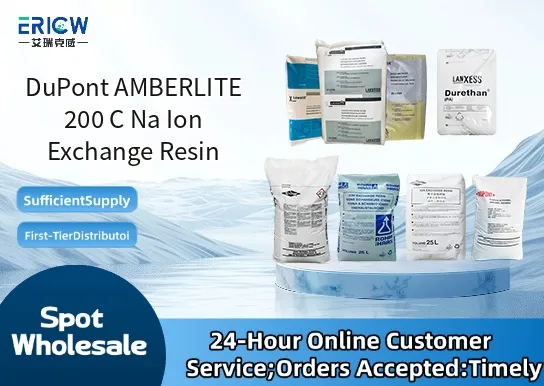
High-capacity, gel-type strong acid cation exchange resin in sodium form.
Excellent physical and chemical stability with consistent bead integrity across wide pH and temperature ranges.
Uniform spherical bead morphology ensures low pressure drop and high flow distribution efficiency.
Optimized for softening applications with rapid kinetics and high regeneration efficiency using NaCl brine.
Complies with NSF/ANSI Standard 61 for drinking water system components.
Municipal and industrial water softening to remove Ca²⁺ and Mg²⁺ ions.
Pre-treatment for reverse osmosis (RO) and deionization (DI) systems.
Boiler feedwater conditioning in power generation and process industries.
Food and beverage processing where sodium-form softening meets regulatory requirements.
Hospital and laboratory pure water generation systems.
| Chemical Type | Strong acid cation (sulfonic acid), sodium form |
| Product Form | Moist, spherical gel beads |
| Appearance | Opaque, light yellow to amber beads |
| Functional Group | –SO₃⁻Na⁺ |
| Ion Exchange Capacity (min.) | 1.8 eq/L (dry) |
| Moisture Content | 45–50% (as shipped) |
| Particle Size Range | 0.3–1.2 mm (95% retained on 16–60 mesh screens) |
| Maximum Operating Temperature | 120 °C (248 °F) |
Q1: What is the primary functional form of AMBERLITE 200 C Na resin?
A: AMBERLITE 200 C Na is supplied in the sodium (Na⁺) form, making it suitable for softening applications where calcium and magnesium ions are exchanged for sodium ions. It is a strong acid cation exchange resin based on a sulfonated polystyrene-divinylbenzene matrix.
Q2: Can this resin be used in potable water treatment systems?
A: Yes, AMBERLITE 200 C Na is commonly used in municipal and residential drinking water softening systems. It meets relevant regulatory requirements for indirect food contact when regenerated with food-grade salt and operated according to standard water treatment practices.
Q3: How is the resin typically regenerated after exhaustion?
A: Regeneration is performed using a brine solution (sodium chloride), usually at concentrations between 8% and 12% w/w. The process involves backwashing, brining, slow rinse, and fast rinse steps to restore exchange capacity and remove displaced hardness ions.
Q4: Is AMBERLITE 200 C Na compatible with high-temperature feedwater?
A: The resin is designed for standard water softening service temperatures up to approximately 120°C (248°F). Prolonged exposure above this range may accelerate physical degradation or reduce operational lifespan, so temperature control is recommended in hot process applications.
Contact With Us:
E-mail: wangxingqiang@ericwchem.com
Have a Questions? Call Us:
Add:
Building A1, Jiete Industrial Park, Huangpu District, Guangzhou City, Guangdong Province, China