English
 Español
 tiếng việt
 русский
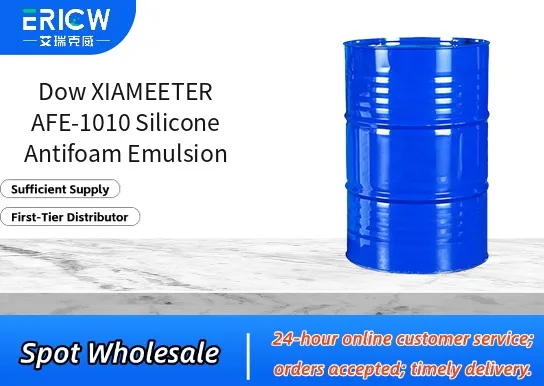
Highly effective silicone-based antifoam with rapid knockdown and long-lasting foam suppression.
Stable oil-in-water emulsion designed for easy dispersion and compatibility in aqueous systems.
Low dosage efficiency—effective at concentrations as low as 10–100 ppm depending on system conditions.
pH-stable across a broad range (pH 2–14), suitable for acidic, neutral, and alkaline process environments.
Non-ionic formulation minimizes interaction with surfactants and ensures compatibility in complex formulations.
Paints and coatings manufacturing—prevents foam during pigment dispersion and let-down stages.
Industrial cleaning formulations—including CIP (clean-in-place) and laundry detergents.
Water-based adhesives and sealants—controls foam during mixing, pumping, and application.
Paper and board coating processes—ensures uniform application and prevents surface defects.
Textile auxiliaries—used in dyeing, printing, and finishing baths to maintain process stability.
| Chemical Type | Dimethylpolysiloxane-based antifoam emulsion |
| Product Form | Oil-in-water (O/W) emulsion |
| Appearance | White to off-white opaque liquid |
| Active Content | 10 wt% silicone active |
| Viscosity (25°C) | 50–150 mPa·s (Brookfield, Spindle #2, 6 rpm) |
| pH (1% aqueous dilution) | 6.0–8.0 |
| Freeze-Thaw Stability | Passes 3 cycles (−10°C for 16 h / 25°C for 8 h) |
| Recommended Storage Temperature | 5–30°C; protect from freezing and prolonged exposure to >40°C |
Q1: What is the primary mechanism of foam suppression for AFE-1010?
A: AFE-1010 functions through silicone-based surface activity—its hydrophobic polydimethylsiloxane (PDMS) component rapidly spreads at the air–liquid interface, destabilizing foam lamellae and promoting coalescence of bubbles. The emulsified structure ensures effective dispersion and sustained antifoam performance in aqueous systems.
Q2: Is AFE-1010 compatible with high-shear processing conditions commonly used in industrial formulations?
A: Yes—AFE-1010 is formulated to maintain emulsion stability under moderate to high shear, making it suitable for use in mixing, homogenization, and pumping operations typical in coatings, adhesives, and water-based cleaning systems. However, prolonged extreme shear may require re-evaluation of dosing or stabilization strategy.
Q3: How should AFE-1010 be incorporated into a formulation for optimal performance?
A: It is recommended to add AFE-1010 during the later stages of formulation—after high-shear dispersion of pigments or fillers—to avoid premature breakup of the emulsion. Pre-dilution with water or a compatible solvent may improve uniformity in low-viscosity systems. Dosage generally ranges from 0.1% to 2% by weight, depending on formulation complexity and foaming tendency.
Q4: Does AFE-1010 leave visible residue or affect gloss in finished films?
A: When used within recommended dosage levels, AFE-1010 typically does not cause visible haze, craters, or significant gloss reduction in dried films. Its finely dispersed silicone phase minimizes surface defects, though compatibility testing in final application matrices (e.g., architectural coatings or paper coatings) is advised to confirm appearance performance.
Contact With Us:
E-mail: wangxingqiang@ericwchem.com
Have a Questions? Call Us:
Add:
Building A1, Jiete Industrial Park, Huangpu District, Guangzhou City, Guangdong Province, China