English
 Español
 tiếng việt
 русский
Excellent abrasion resistance for extended service life in demanding mechanical environments.
High tensile strength and elongation at break, enabling superior flexibility and impact resilience.
Good low-temperature flexibility down to –30 °C without significant loss of elasticity.
Outstanding oil, grease, and hydrocarbon resistance compared to conventional thermoplastics.
Processable via standard thermoplastic methods including extrusion, injection molding, and calendering.
Industrial hoses and fluid transfer tubing requiring high burst pressure and kink resistance.
Dynamic seals and gaskets for automotive and hydraulic systems operating under cyclic stress.
Wear-resistant conveyor components such as scraper blades, rollers, and linings.
High-performance footwear midsoles and outsoles demanding rebound, durability, and weather resistance.
Protective coatings and encapsulation layers for electronic assemblies exposed to mechanical stress.
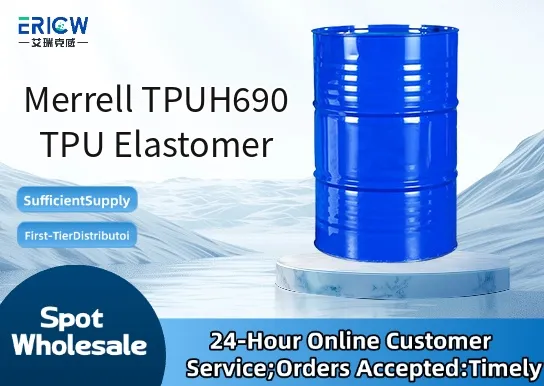
| Chemical Type | Thermoplastic Polyurethane (TPU), Polyester-based |
| Product Form | Pellets |
| Appearance | Opaque, light tan to beige granules |
| Primary Applications | Dynamic elastomeric components, wear parts, flexible industrial profiles |
| Key Features | High hardness (Shore A 69), excellent tear strength, good UV stability |
| Processing Temperature Range | 180–220 °C (recommended melt temperature) |
| Density | 1.18–1.20 g/cm³ |
| Moisture Content (as received) | ≤0.15 wt% (pre-drying recommended before processing) |
Q1: What is the primary processing method recommended for Merrell TPUH690?
A: Merrell TPUH690 is specifically formulated for melt-processing techniques including extrusion, injection molding, and calendering. It exhibits excellent melt stability and low viscosity at typical processing temperatures, enabling smooth flow and good surface finish in finished parts.
Q2: Is Merrell TPUH690 suitable for applications requiring resistance to hydrolysis and UV exposure?
A: Yes — as a polyester-based thermoplastic polyurethane, Merrell TPUH690 offers inherently good mechanical retention in humid or warm environments. For extended outdoor use, it is recommended to incorporate appropriate UV stabilizers and antioxidants into the final compound formulation.
Q3: Can Merrell TPUH690 be blended with other polymers to modify performance?
A: Merrell TPUH690 demonstrates good compatibility with various engineering thermoplastics such as PC, ABS, and certain grades of polyesters. Blending is commonly used to enhance toughness, improve processability, or tailor hardness — however, compatibility should always be verified through small-scale trials and rheological assessment.
Q4: What drying conditions are recommended prior to processing?
A: To ensure optimal processing and mechanical properties, Merrell TPUH690 should be dried to a moisture content below 0.05% before melt processing. A typical drying regimen involves 3–4 hours at 80–90 °C using a desiccant dryer with dew point control.
Contact With Us:
E-mail: wangxingqiang@ericwchem.com
Have a Questions? Call Us:
Add:
Building A1, Jiete Industrial Park, Huangpu District, Guangzhou City, Guangdong Province, China